Sectoral productivity convergence, input-output structure, and network communities in Japan
Abstract
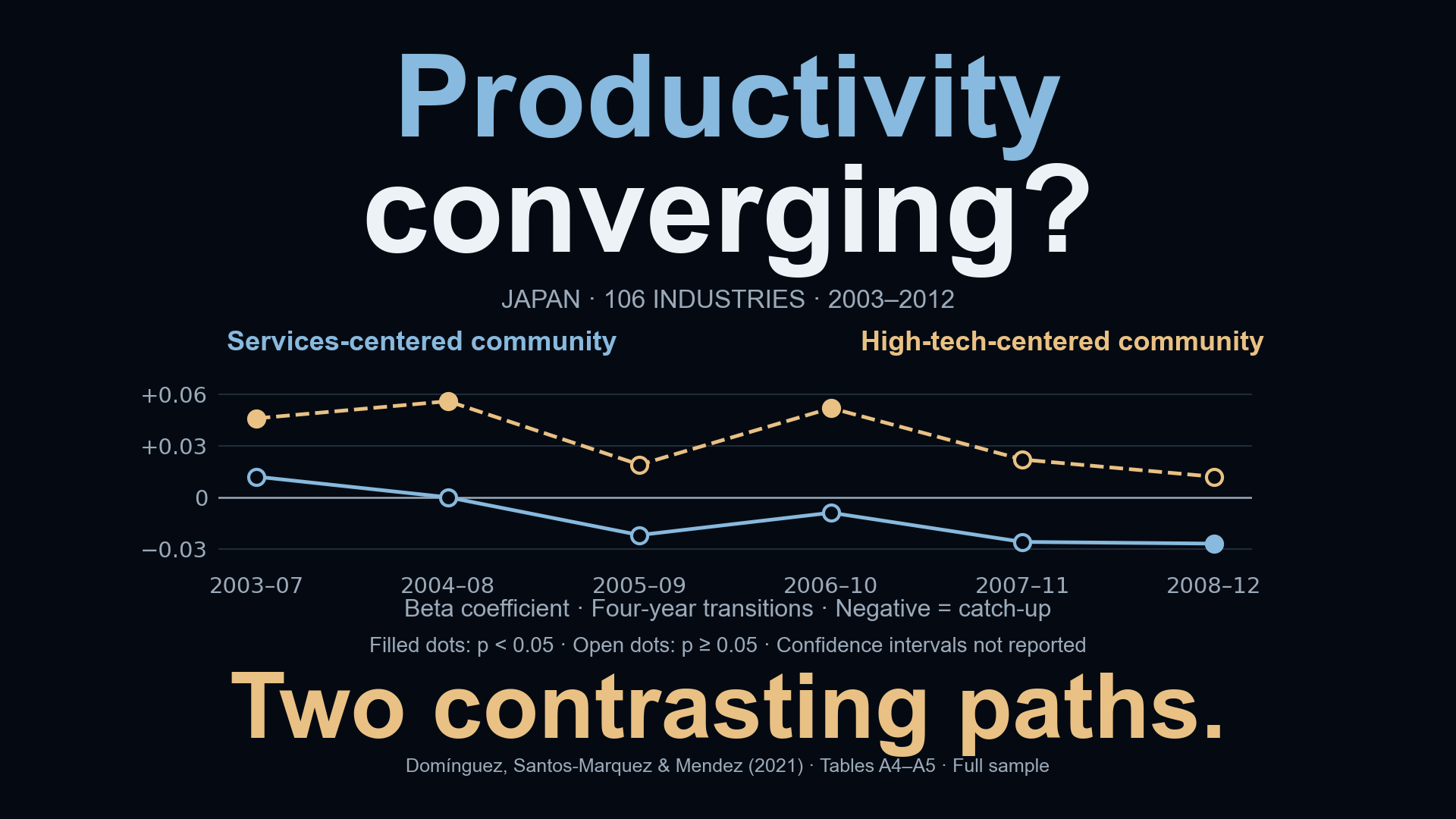
We study sectoral productivity convergence through the input-output structure of the economy and its network representation. In particular, we study 106 production sectors in Japan over the 2003-2012 period and identify highly interconnected sectors using community detection algorithms. We next characterize the dynamics of these communities by evaluating the evolution of productivity dispersion using parametric and nonparametric frameworks of sectoral productivity convergence. We find two dominant communities: The central members of community 1 are mostly service-related industries, while the central members of community 2 are mostly high-tech manufacturing industries. The convergence analyses indicate that the two communities have contrasting convergence-divergence patterns. Robust convergence is only found for community 1. In contrast, community 2 appears to be the source of the weak divergence pattern that is observed across all industries in Japan.

Carlos Mendez
Associate Professor of Development Economics
My research interests focus on the integration of development economics, spatial data science, and econometrics to better understand and inform the process of sustainable development across regions.