Do Industrial Parks Work?

Evaluating place-based policy in Ethiopia with staggered difference-in-differences

+0.215***IHS night-light per park
4 estimators agreeTWFE · SA · BG · CS
+0.140***female jobs · null on average

Carlos Mendez

Nagoya University (GSID)

June 12, 2026

The Tension

Act I

Governments spend billions fencing land for factories — does anything grow outside the fence?

An industrial park: serviced land, power, one-stop customs — rented to garment and leather factories. Ethiopia opened 20+ parks across 18 districts, 2008–2021.

The promise: jobs, a wage economy, a rural region pulled forward. The fear: a bright enclave behind a fence while the surrounding districts see nothing.

The question has two halves — whether, and for whom

A park could raise satellite luminosity yet leave living standards flat. It could add jobs on average — yet only for men.

So we ask both: do parks raise local activity, and who inside the district actually benefits?

The “for whom” turns out to carry the headline.

The government did not flip a coin — parks went where growth already was

Parks were sited near cities and roads — districts that were already growing faster. So a naive treated-vs-control gap confounds the park with the place.

We need a design that nets out pre-existing differences and handles a staggered rollout (parks opened in different years). That design is difference-in-differences.

A note on the data. Synthetic, calibrated data — tuned to Huang, Wang & Xu (2026)’s signs and magnitudes. Learn the methods, not facts about Ethiopia.

One estimand — the ATT — threads through everything

We want the Average Treatment effect on the Treated:

\[\text{ATT} = E[\,Y_i(1) - Y_i(0) \mid D_i = 1\,]\]

The effect on the 17 districts that got a park — not on a random district — identified under parallel trends.

  • Naive 2×2 — the cartoon
  • TWFE + event study — the workhorse
  • Sun-Abraham · Borusyak · Callaway-Sant’Anna — the insurance

Three data streams · one design · an escalating ladder of estimators.

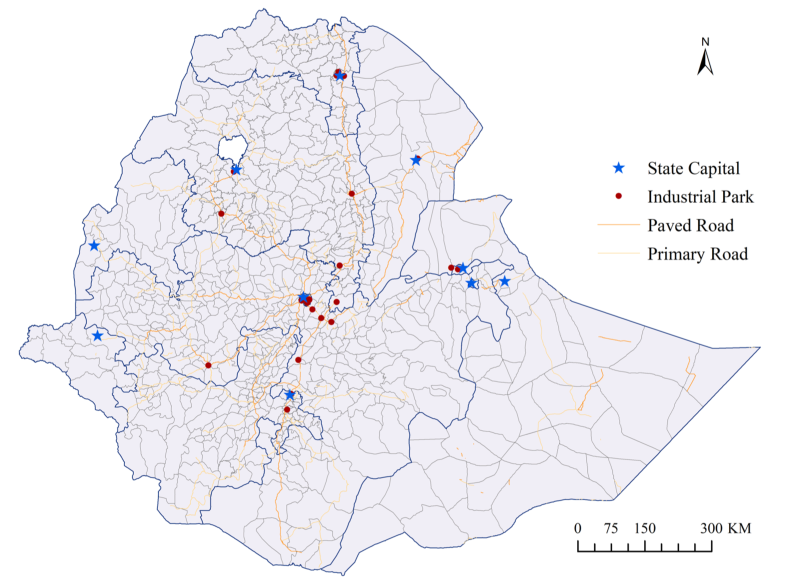
Where the industrial parks are located

Ethiopia’s industrial parks (red dots), regional state capitals (blue stars), and the paved and primary road network.

Source: Appendix Figure A2 in Huang, Wang & Xu (2026). Real park locations from the paper; this tutorial uses synthetic calibrated data.

The Investigation

Act II

One policy, measured at three grains — satellite, household, individual

Satellite panel

  • 139 woredas × 16 years (2,224 rows)
  • 17 treated vs 122 matched controls
  • outcome: IHS nighttime light

DHS repeated cross-sections

  • 13,200 households · 17,900 individuals
  • 5 survey rounds, fresh respondents
  • no panel key → coarse event phases

Only 17 treated woredas — the recurring source of statistical caution.

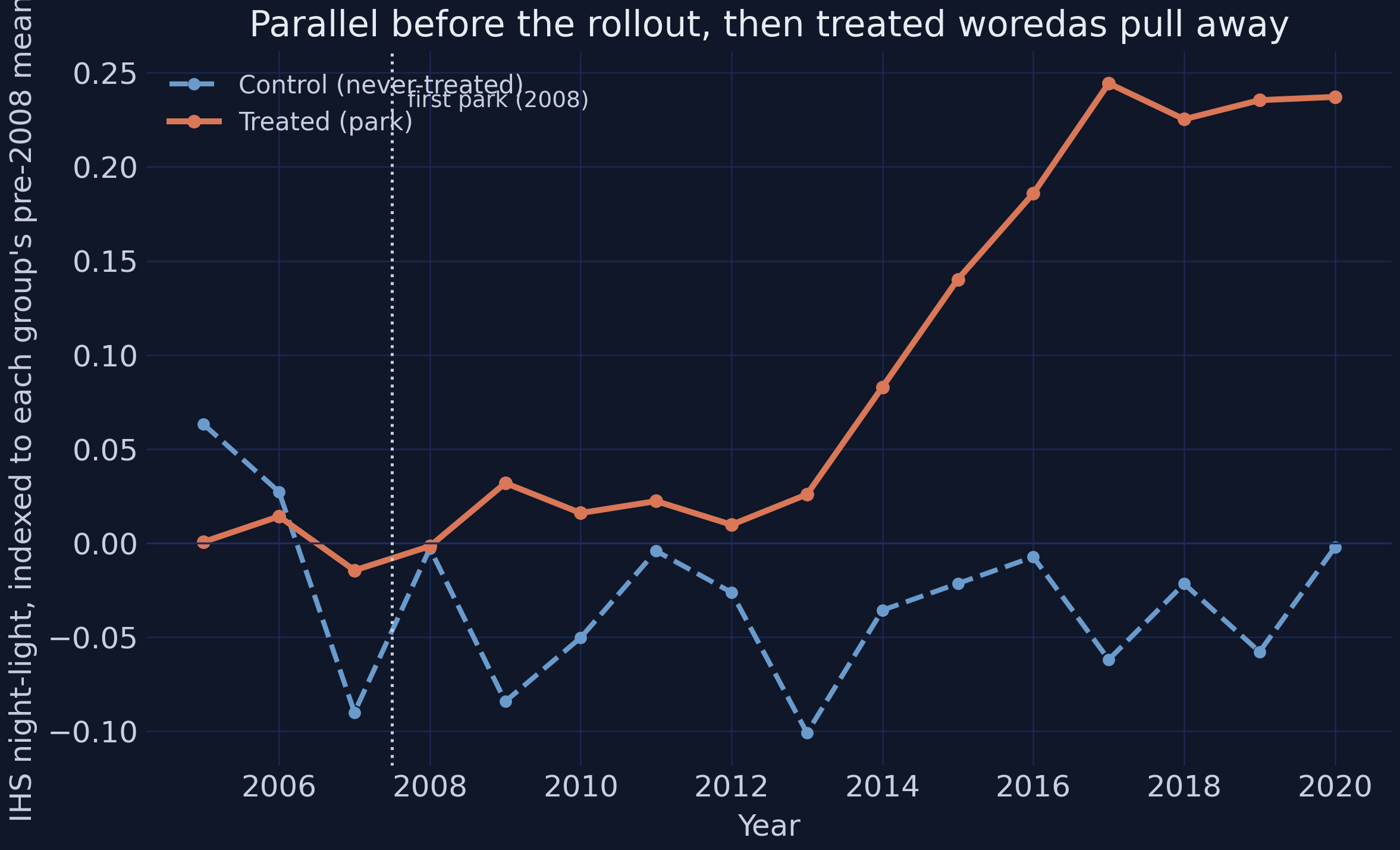
Parallel before the rollout, then the treated woredas pull away

Baseline-normalized group-mean IHS light: treated (orange) and control (blue) overlap before 2008, then the treated series climbs while controls stay flat.

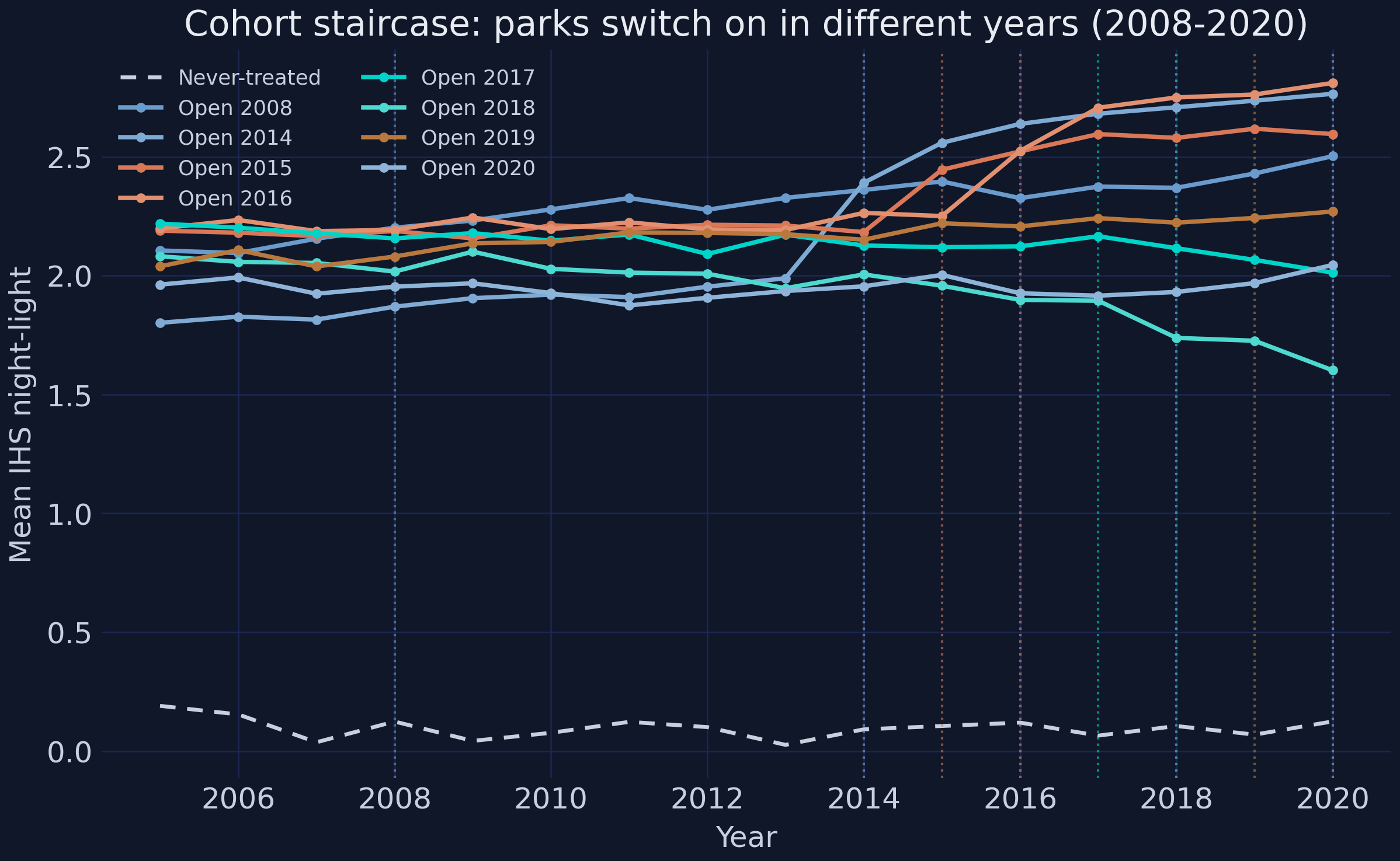
Staggered means there is no single “before” — each cohort has its own clock

Cohort staircase: each opening-year cohort turns up at its own park-opening date against a flat never-treated baseline.

1 woreda in 2008, then 2–3 per year across 2014–2020 — 17 in total.

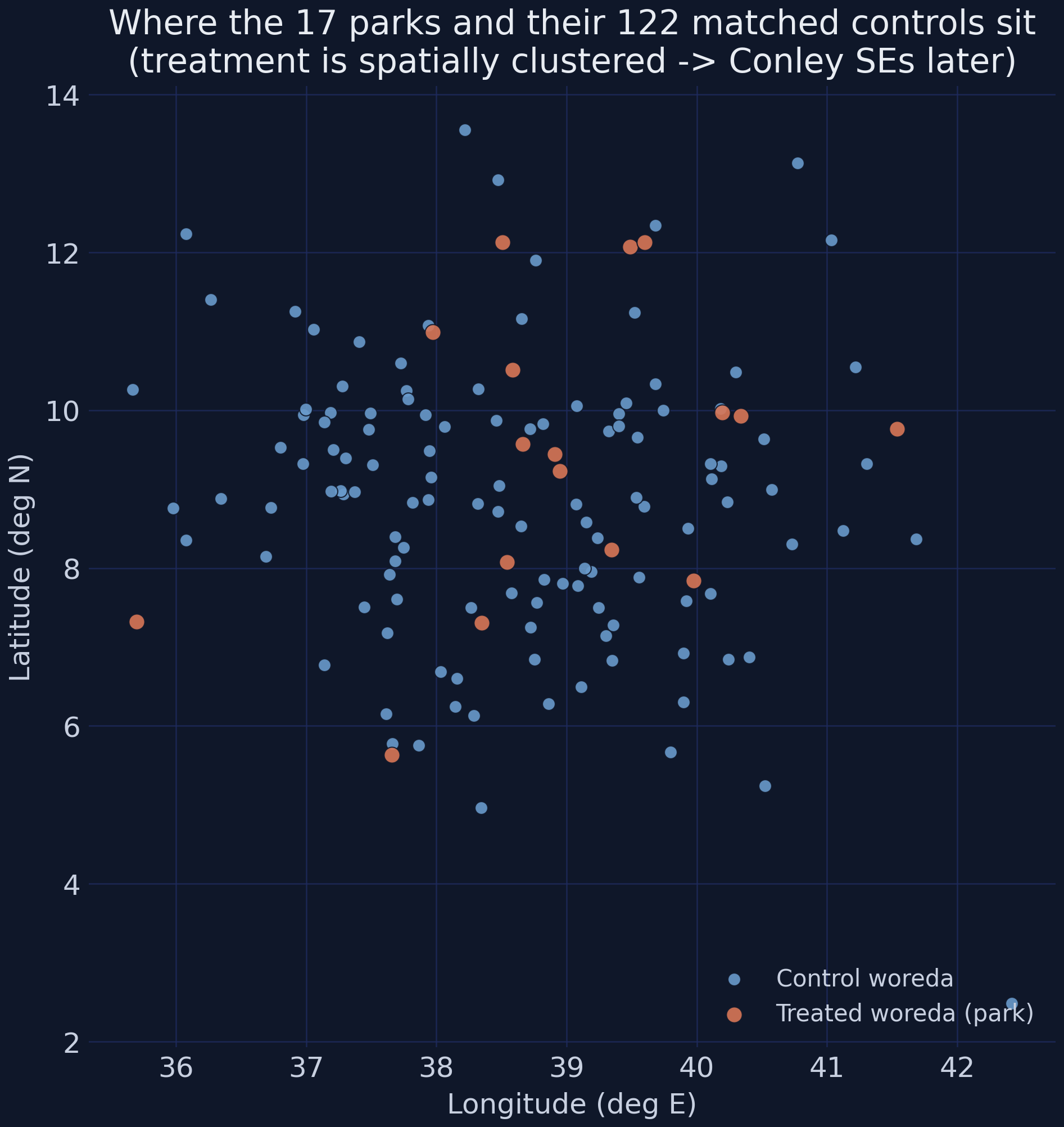
Treatment is spatially clustered — which will matter for standard errors

Treatment map: the 17 treated woredas (orange) cluster spatially among the 122 matched controls (blue).

Near things are more related than distant things — their shocks are not independent draws.

A single “after” blends the slow start with the late surge — and understates the effect

The simplest estimate collapses the design at the median opening year and takes a difference of differences:

\[\widehat{\text{DiD}} = \big(\bar{Y}_{\text{treat, post}} - \bar{Y}_{\text{treat, pre}}\big) - \big(\bar{Y}_{\text{ctrl, post}} - \bar{Y}_{\text{ctrl, pre}}\big)\]

Naive 2×2 ATT: +0.2011 (SE 0.0885, p = 0.023).

The effect ramps over ~5 years, so averaging small early years with large late ones pulls the mean down.

The workhorse adds two-way fixed effects — and a park lifts light +0.215

The static TWFE specification, for woreda \(d\) in year \(t\):

\[Y_{dt} = \beta \, D_{dt} + \alpha_d + \gamma_{r(d),t} + \varepsilon_{dt}\]

\(\alpha_d\) absorbs the bright base; \(\gamma_{r(d),t}\) absorbs regional shocks; \(\beta\) is the ATT.

With baseline-trend interactions: \(\hat\beta = +0.2152\) (SE 0.0833, \(t = 2.58\), sig. at 1%) — a ~21% rise in luminosity.

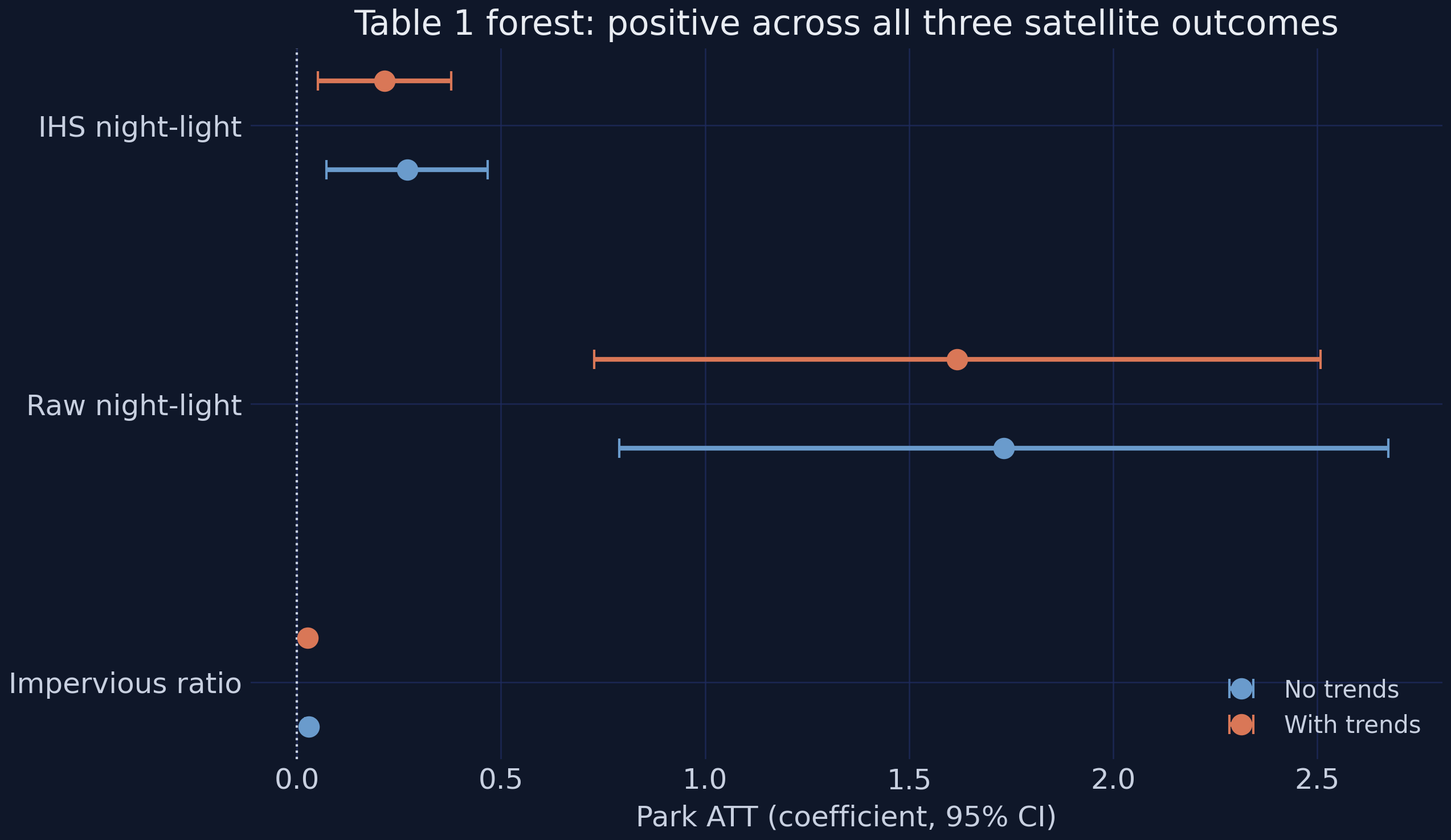
Across all three satellite outcomes the park effect is positive

Table 1 forest: a positive park ATT across IHS light, raw light, and the impervious-surface ratio, no-trends vs with-trends.

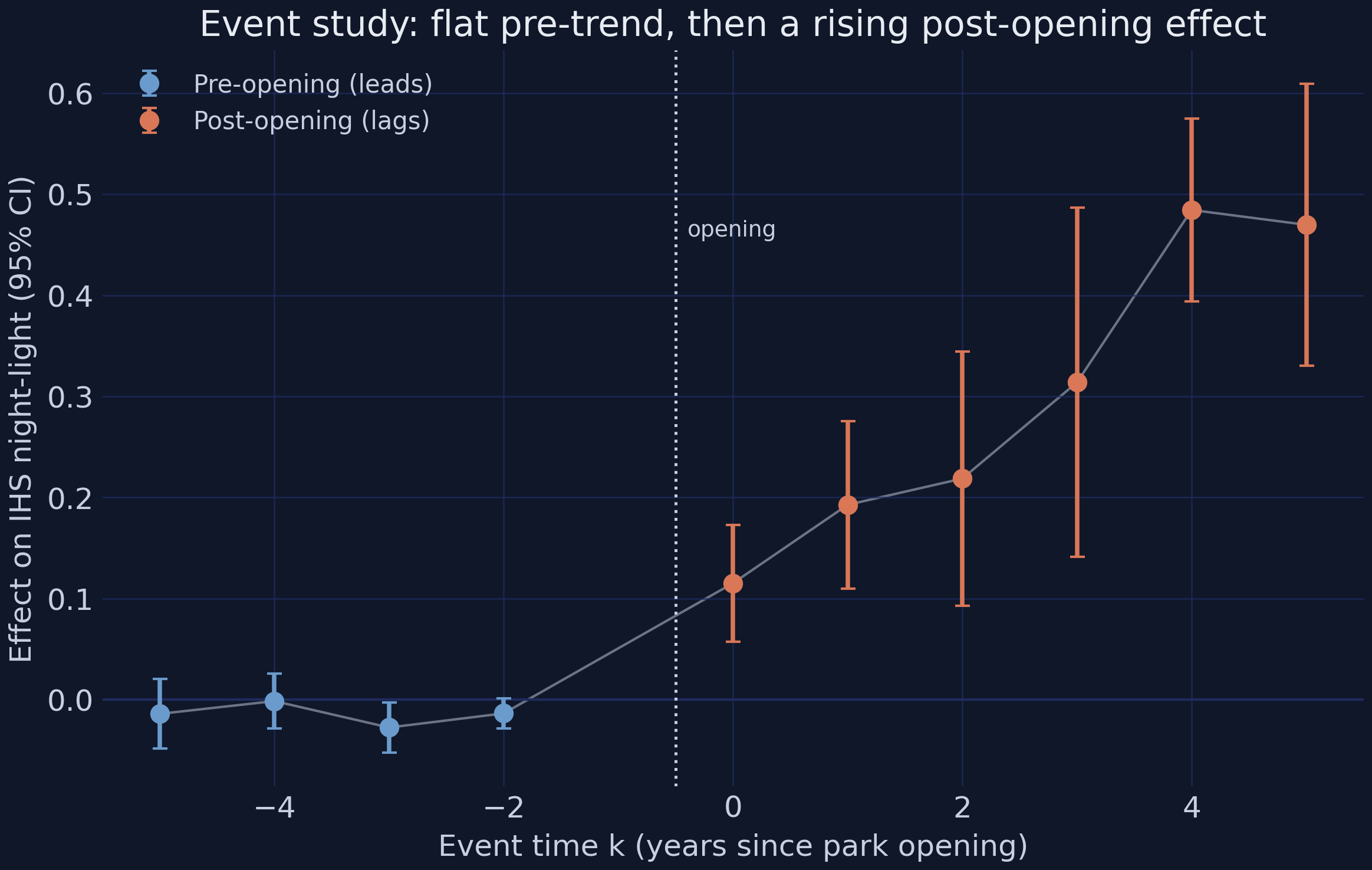
The event study shows when the effect arrives — flat before, rising after

Event study: the four pre-opening leads hug zero, then the effect jumps at k = 0 and climbs to a +0.48 plateau by k = 4–5.

Pre-trend flat (largest \(|t| = 2.17\)) → parallel trends credible. Effect builds, not jumps.

The teaching moment: staggered TWFE can use already-treated units as controls

The worry. Under staggered timing TWFE makes “forbidden comparisons” — already-treated woredas as controls for later-treated ones. When effects grow over time, those comparisons get negative weights and can bias, even flip, the estimate.

The fix. Sun-Abraham, Borusyak/Gardner, and Callaway-Sant’Anna only ever compare treated cohorts to clean (never- or not-yet-treated) controls. Each targets the same ATT — if they agree with TWFE, the bias is not biting.

Four estimators, one estimand — they agree within 0.046 IHS units

Four estimators compared: TWFE +0.270, Sun-Abraham +0.299, Borusyak/Gardner +0.302, Callaway-Sant’Anna +0.256 — all in a tight band, each significant at 1%.

Estimator ATT Sig.
TWFE +0.2699 ***
Sun-Abraham +0.2991 ***
Borusyak/Gardner +0.3022 ***
Callaway-Sant’Anna +0.2561 ***

And the Goodman-Bacon decomposition shows why — 95.4% clean weight

Goodman-Bacon decomposition: the clean treated-vs-never 2×2 comparisons carry nearly all the weight; the forbidden later-vs-earlier comparisons carry almost none.

Comparison type Weight Avg estimate
Treated vs never 95.42% +0.2708
Earlier vs later 3.38% +0.3370
Later vs earlier (forbidden) 1.21% +0.0135

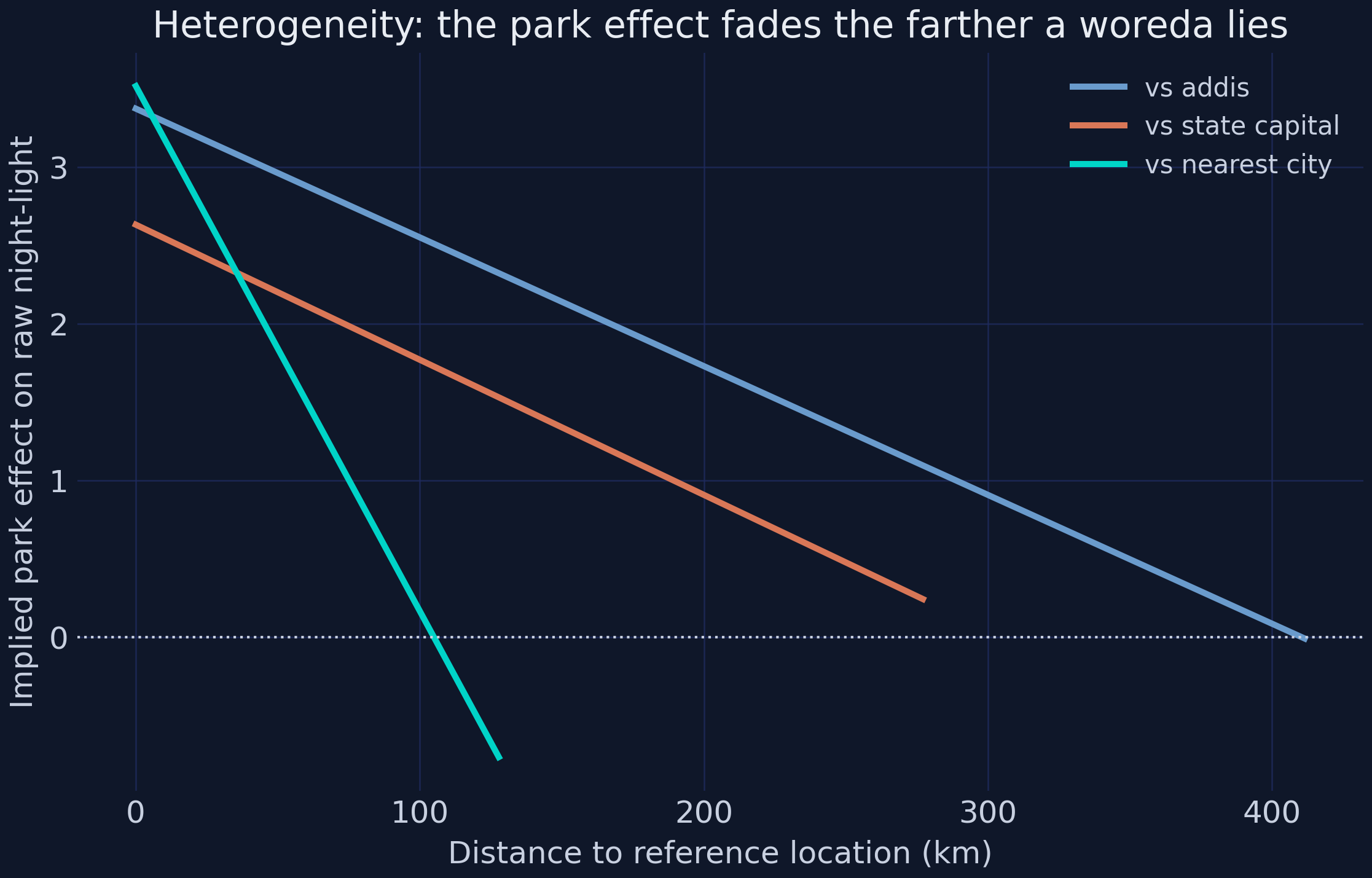
Where parks work: the effect fades with distance and is amplified by roads

Heterogeneity: the implied park effect fades the farther a woreda lies from Addis, its state capital, or the nearest city.

Distance to nearest city \(-0.0335\) (\(t = -4.90\)) · paved roads \(+0.6695\) (\(t = 2.08\)). Place is first-order.

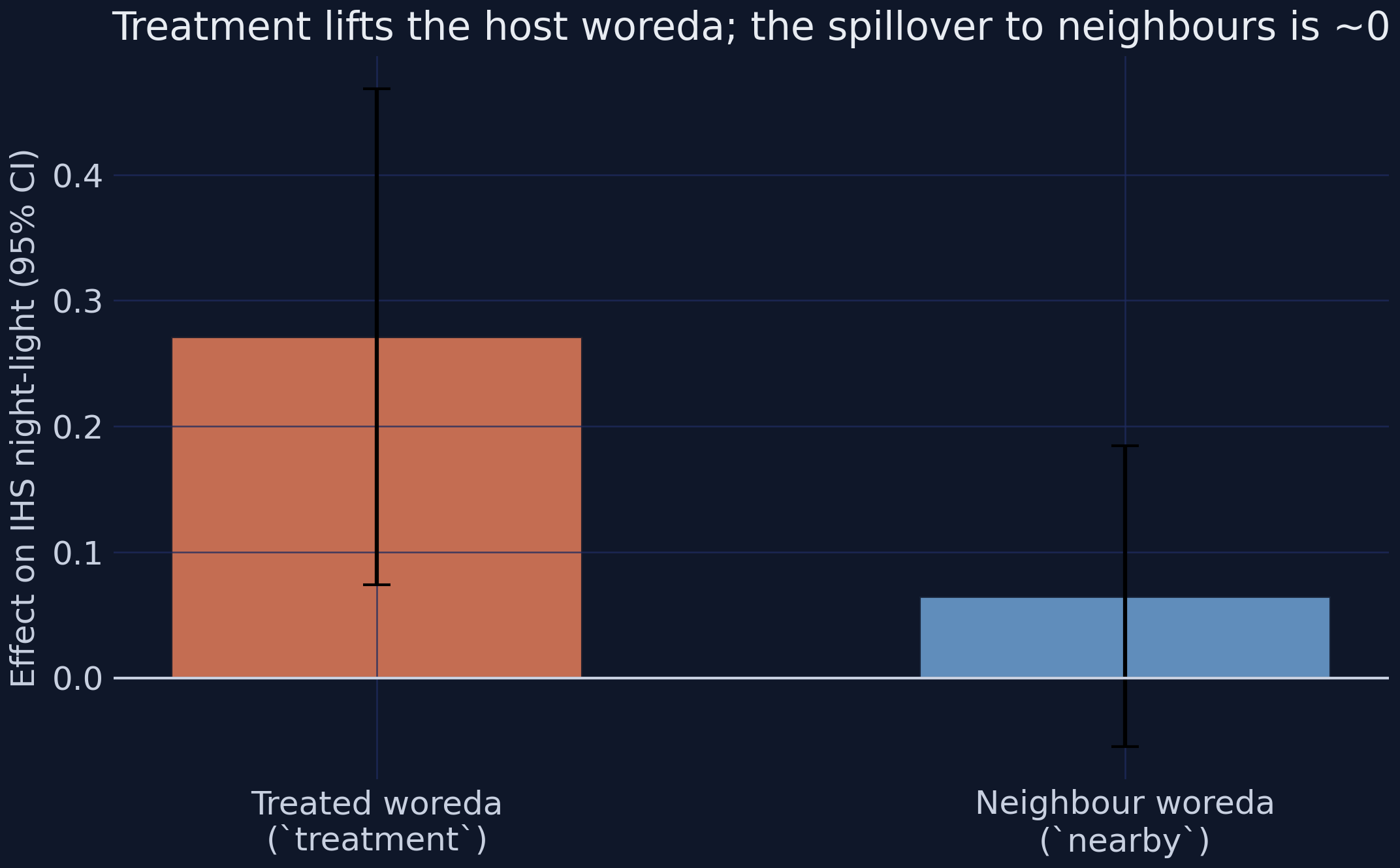
Net-new activity, not displacement — no measurable spillover to neighbours

Spillover test: treatment lifts the host woreda strongly (+0.27), but the effect on control neighbours within 10 km is about zero.

nearby \(= +0.0648\) (\(t = 1.06\)), insignificant — so the host’s gain is net-new, and SUTVA holds.

Households near a park gain durables, housing, and wealth

Table 5 forest: households near a park gain durable goods, housing quality, and wealth, with or without controls.

Outcome ATT (with controls) Sig.
Durable goods p.c. +0.2286 (~74%) ***
Housing quality +0.2480 ***
Wealth index +0.3825 SD ***

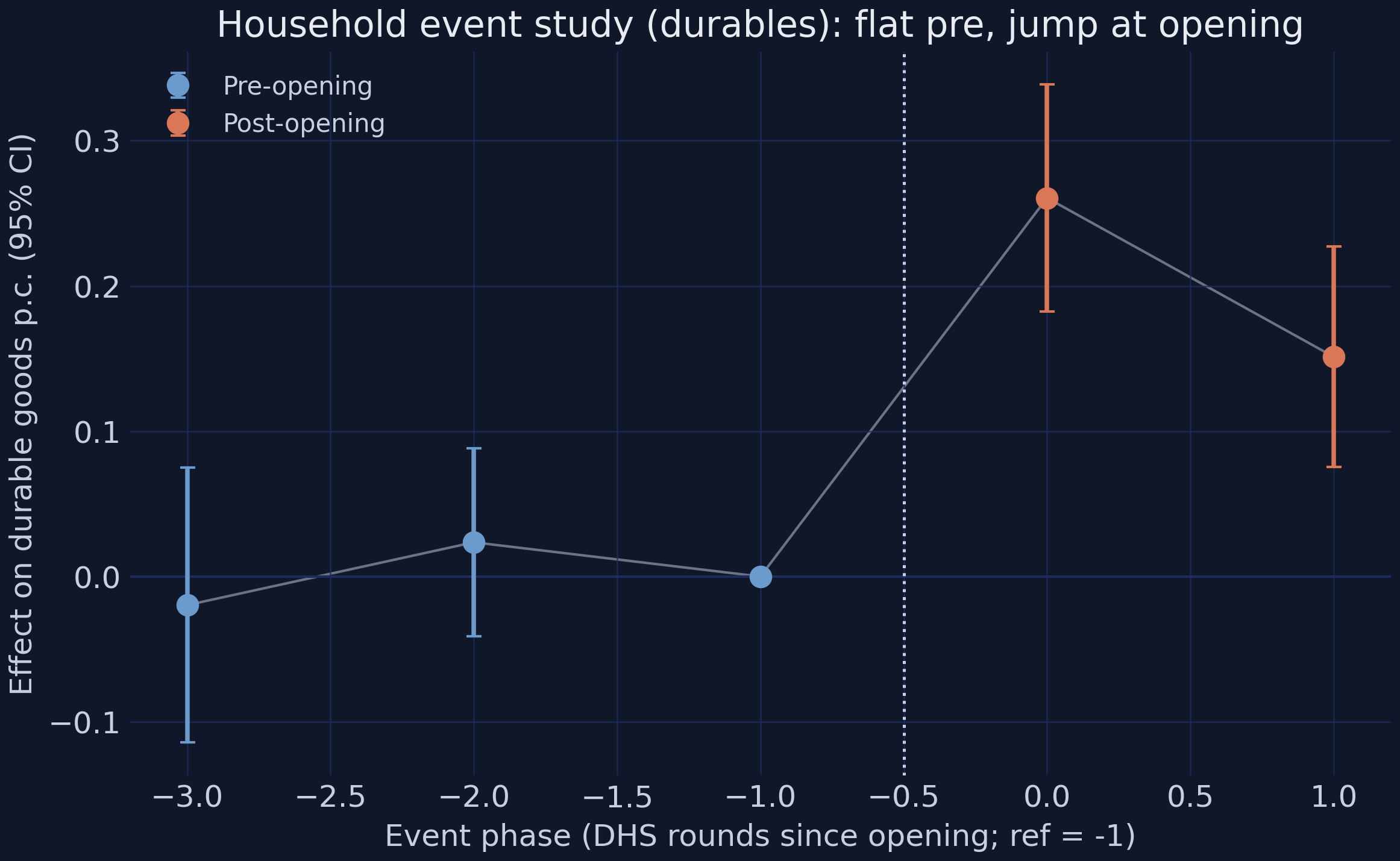
Clean timing in the survey data too — flat pre-phases, then a jump

Household durables RCS event study: flat, insignificant pre-phases, then a jump at park opening (phase 0).
Phase \(-3\): \(-0.020\) (ns) · phase \(-2\): \(+0.024\) (ns) · phase \(0\): \(+0.261\) (p < 0.001).

The climax: average employment is null — but the female effect is large

The gender story: employment is null overall but large for women; women’s decision power and savings rise while acceptance of domestic violence falls.

Non-ag employment ATT \(t\)
Full sample +0.0911 (ns) +1.57
Women +0.1404*** +3.00
Men +0.0176 (ns) +0.19

Factory jobs cascade into agency — power up, savings up, DV-acceptance down

+0.140

women’s non-ag employment ATT (p < 0.01) — and the empowerment cascade that follows

Decision power +0.110*** · savings account +0.315*** · accepts domestic violence −0.210*** (women only).

The Resolution

Act III

Honest inference inflates the SE 2.4× — but the headline survives

Treated woredas cluster in space, so a regional shock hits several at once — the naive SE assumes independence and is too small. The fix is a Conley spatial-HAC standard error; the point estimate never moves.

With-trends light ATT Estimate Naive HC0 Conley-HAC \(t\)(HAC)
2008–2020 +0.2152 0.0329 0.0799 +2.69

Same +0.2152 in every column. The SE inflates 2.43× — yet still significant at 1%.

Four findings, one story: well-sited parks reshape activity — through women

  • Activity — +0.215 IHS light (~21%), +2.6 pp built-up land, no spillover
  • Staggered-robust — four estimators agree within 0.046, 95.4% clean Bacon weight
  • Welfare — durables +0.229, housing +0.248, wealth +0.383 SD
  • Gender — null on average (+0.091), but female jobs +0.140 and the agency cascade

Triangulation across methods — not a single regression — is what makes the claim credible.

Two design lessons: follow the roads, and disaggregate by sex

The lesson is not “build parks everywhere.” It is that where and for whom decide whether place-based policy works.

  • Site selection — the effect fades −0.0335 per km to the nearest city and is amplified by paved roads. A park in a remote, poorly-connected woreda would do far less.
  • Inclusion — gains run through female-intensive sectors. An evaluation that measured only the average would conclude the parks failed on jobs and miss their largest social return.

The strongest objection — and the answer

Objection. The data are synthetic, there are only 17 treated woredas, and this is observational — point estimates fragile, identification on faith.

Response.

  • Synthetic data are calibrated to the paper — audited cell by cell in Section 13.
  • Small-N met head-on: flat pre-trends, null spillover, four-estimator agreement, Conley-HAC errors.
  • The caveats narrow the claim — they don’t overturn it.

Five numbers to remember

Number Value
Light ATT (with trends) +0.2152*** (~21%)
Four-estimator spread 0.046 IHS units
Clean Bacon weight 95.4%
Female employment ATT +0.140*** (vs +0.091 ns)
Light SE: naive → Conley-HAC 0.0329 → 0.0799

And five lessons: let evolving effects evolve · triangulate estimators · disaggregate by sex · place is first-order · honest inference, honest caveats.

Well-sited parks reshape a local economy — and women’s lives — but only a sex-disaggregated look reveals it.