A magnitude-9.1 quake, a wave 9 km inland, and ~130,000 lives lost in one province
A third of Aceh’s coastline, flooded in one morning. Then the largest reconstruction effort ever aimed at a developing-world disaster — about USD 7.0 billion, well spent.
A decade later: was Aceh richer or poorer than without the wave?
And how could you ever measure that credibly?
You only ever observe the world where the tsunami did happen
We need Aceh’s counterfactual: its output with no tsunami.
That world is never observed — only estimated.
Our target is the ATT — the average effect of the treatment on the treated:
\[\text{ATT} = E[\,Y(1) - Y(0) \mid D = 1\,]\]
The effect on the flooded districts — not on some randomly chosen district.
The wave’s path was geography, not choice — that is what makes it a natural experiment
Elevation, vegetation, and offshore depth decided which coast flooded.
Geography chose the treatment — not economics.
So flooded vs spared is plausibly unrelated to a district’s prospects.
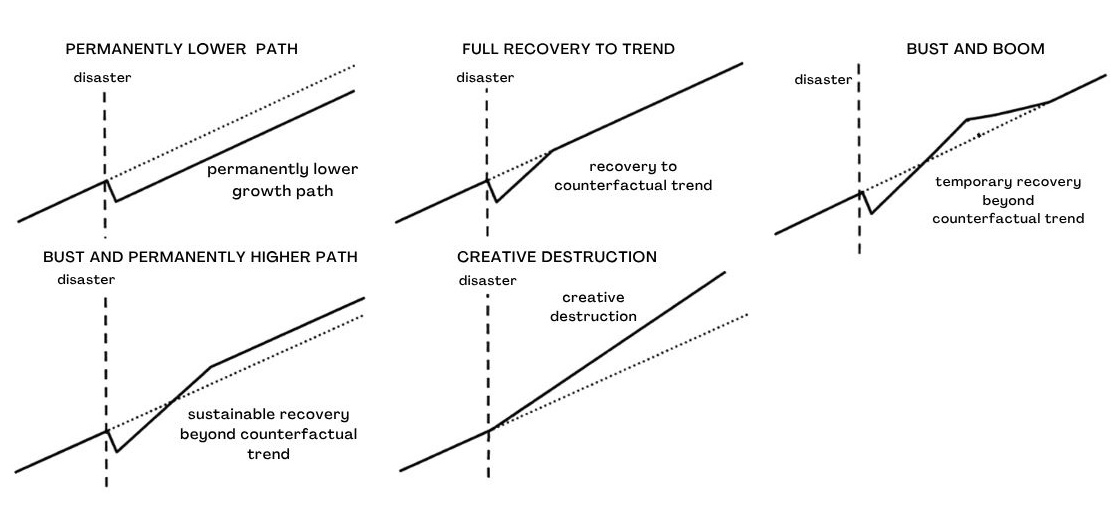
Five paths a shocked economy can take
After the wave, Aceh could have landed on any of these paths.
The dotted line is the no-tsunami counterfactual.
A typology of post-disaster recovery paths, each plotted against its no-disaster counterfactual trend: permanently lower path, full recovery to trend, bust and boom, bust and permanently higher path, and creative destruction.
Which one did Aceh take? Act II finds out.
The Investigation
Act II
The data are synthetic — learn the methods, not the facts
A note on the data. The panels are synthetic and calibrated to Heger and Neumayer’s (2019) signs, significance, and magnitudes.
Learn the methods, not new facts about Aceh.
One disaster, measured at two grains — district GDP and sub-district night-lights
District GDP
125 Sumatran districts, 1999–2012
10 flooded Aceh districts treated
outcome: real GDP growth
Sub-district night-lights
276 Aceh sub-districts, DMSP-OLS luminosity
continuous dose: share flooded
outcome: log-luminosity growth
Only 10 treated units — the recurring source of statistical caution.
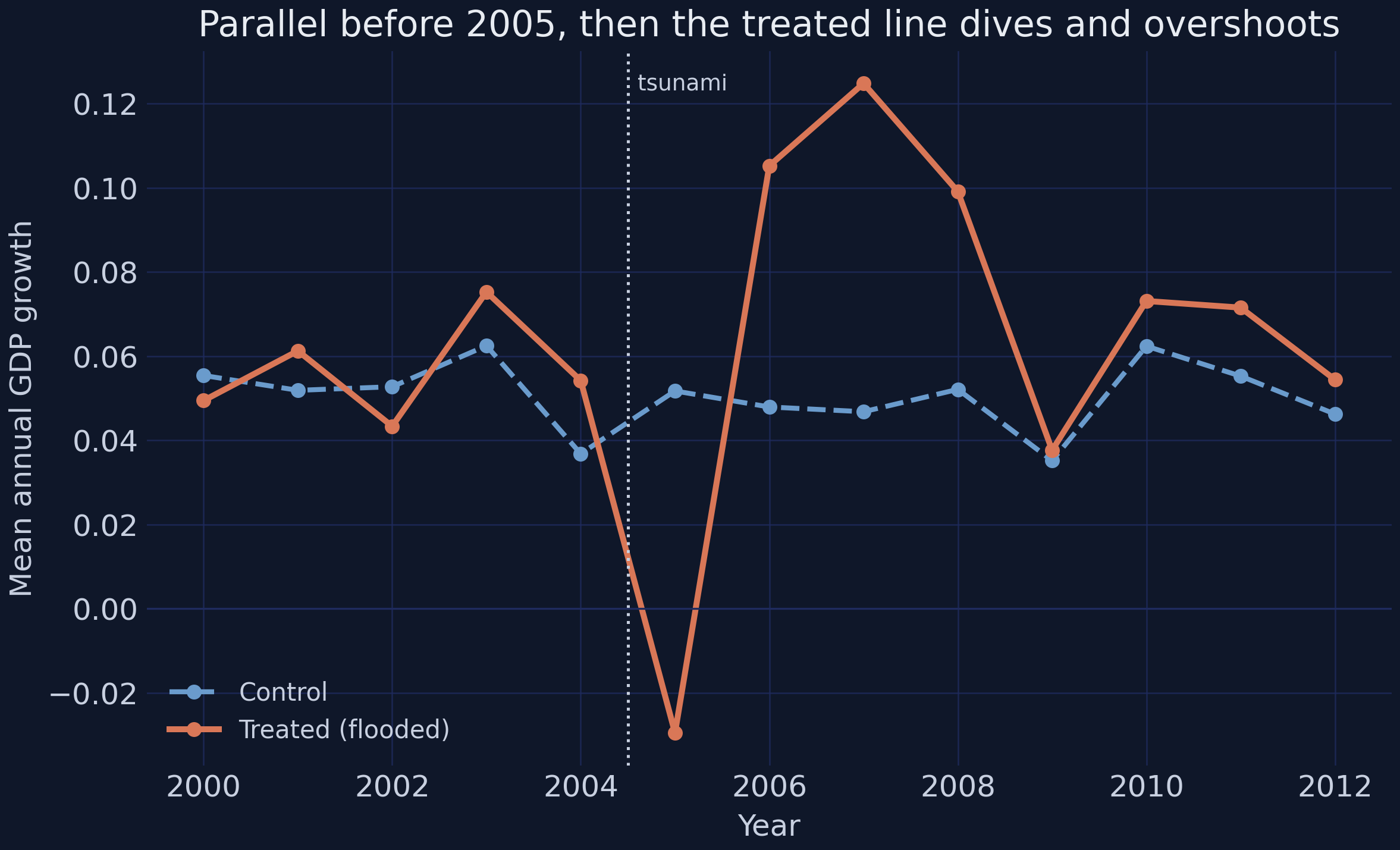
Parallel before 2005, then a dive and an overshoot
Treated (orange) vs control (blue) group-mean growth: lockstep before the tsunami, then the treated line plunges to \(\approx -0.027\) and overshoots to \(\approx +0.124\) in 2007.
The eye is convinced — the rest of the talk attaches a margin of error.
A single “after” hides the story
The simplest DiD splits time into before/after and takes the difference of the two changes:
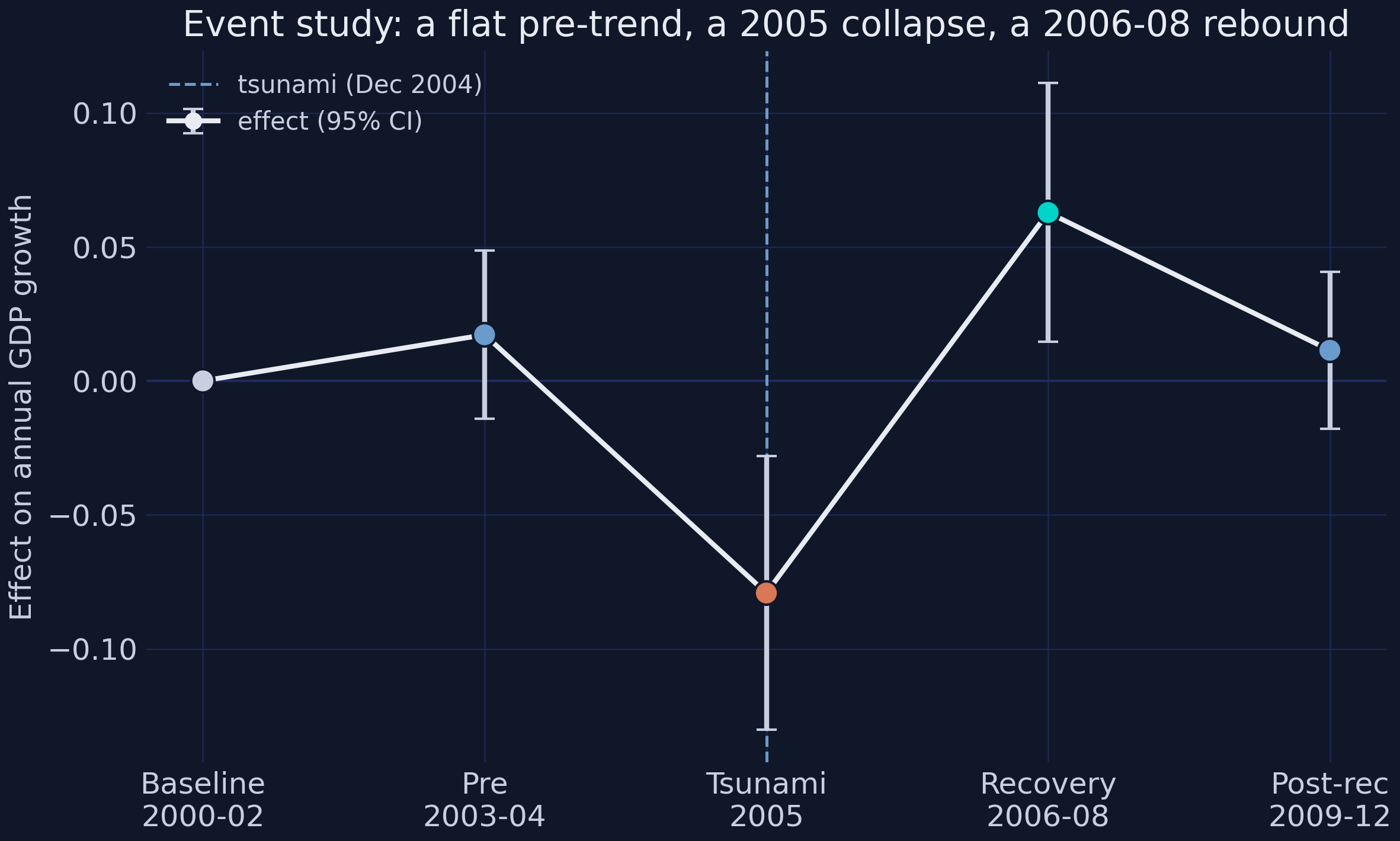
Flat pre-trend → parallel trends holds. The gain persists but doesn’t compound → a permanently higher path.
The event study shows why the pooled average misled
Treated-minus-control effect by period (95% CIs): baseline and pre-trend sit on zero, 2005 collapses to −0.079, recovery rebounds to +0.063, then drifts back but stays positive.
Flat pre-trend, sharp collapse, significant rebound, a persistently higher level.
Not a denominator artifact — per-capita recovery is even larger
A worry: maybe “growth” rose only because population fell (130,000 deaths and displacement). Re-running the DiD on GDP per capita:
+0.0827
recovery coefficient on per-capita growth, p < 0.01 — output per person rose, not just totals
Fewer people then shared a rebuilt, better-capitalized economy.
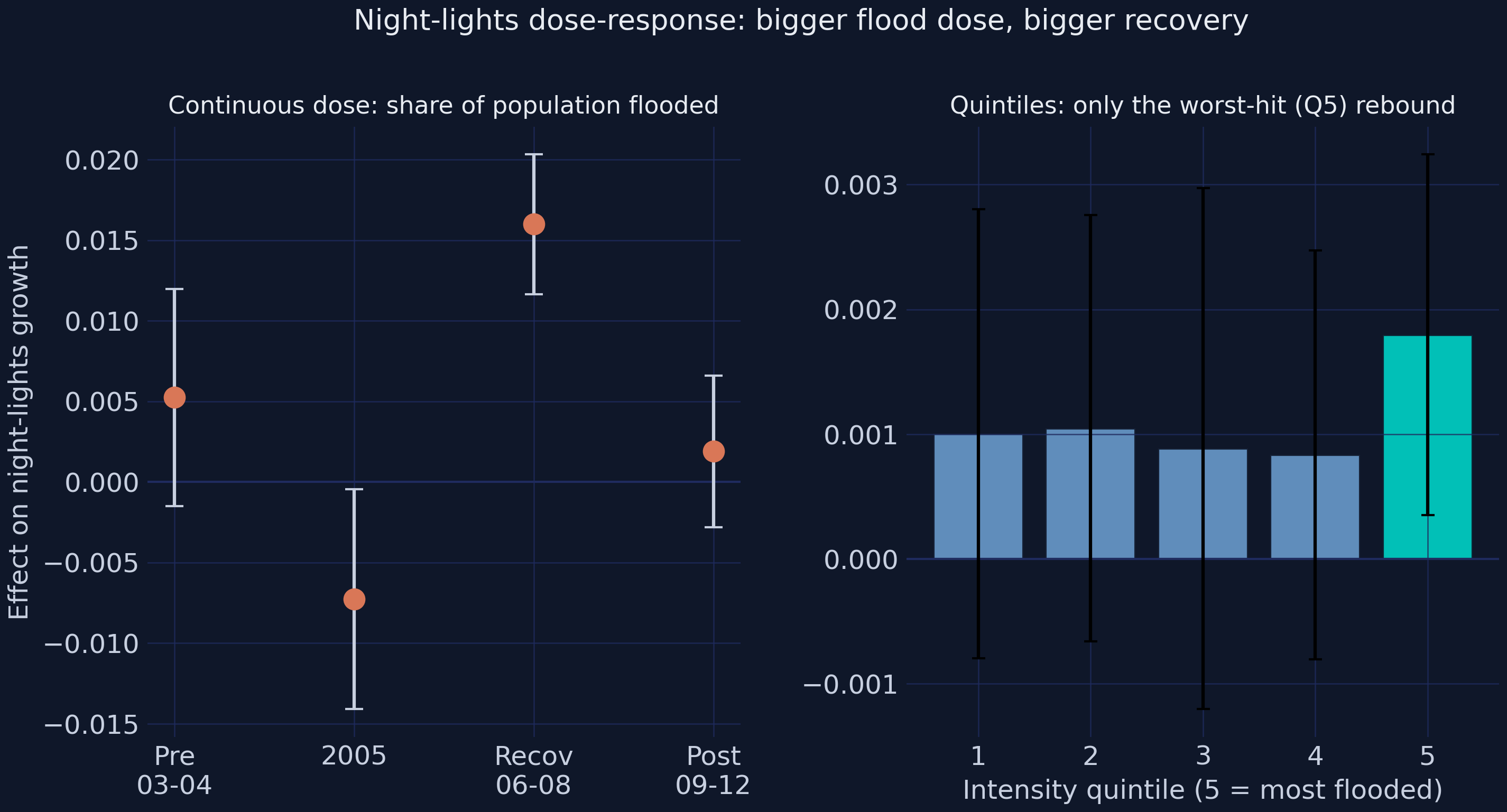
The harder-hit rebounded more — and only the worst-hit fifth significantly
Night-lights dose-response: continuous period effects (left) and effect by flood-intensity quintile (right) — only Q5, the most heavily flooded sub-districts, rebounds significantly.
Quintile
Q1
Q2
Q3
Q4
Q5 (worst-hit)
Recovery effect
+0.0010
+0.0010
+0.0009
+0.0008
+0.0018**
The rebound concentrates where the damage — and the spending — was greatest.
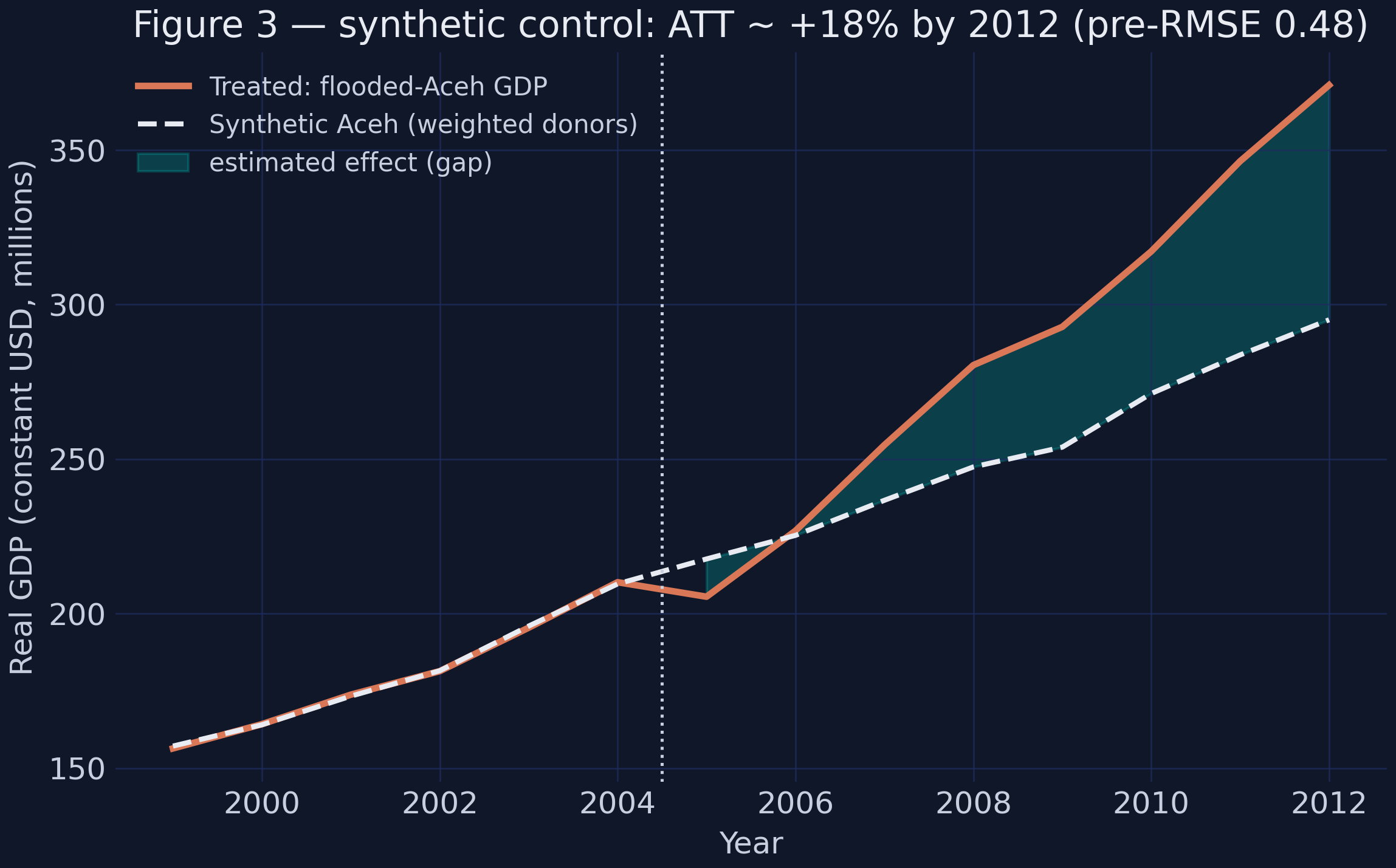
A synthetic Aceh, built from 76 donors, tracks the pre-2005 path almost exactly
Synthetic Aceh tracks the real path before 2005 (pre-RMSE 0.485); afterward the actual line pulls above.
Pick donor weights that best match Aceh before 2005.
A near-perfect pre-2005 fit is what licenses trusting the counterfactual after.
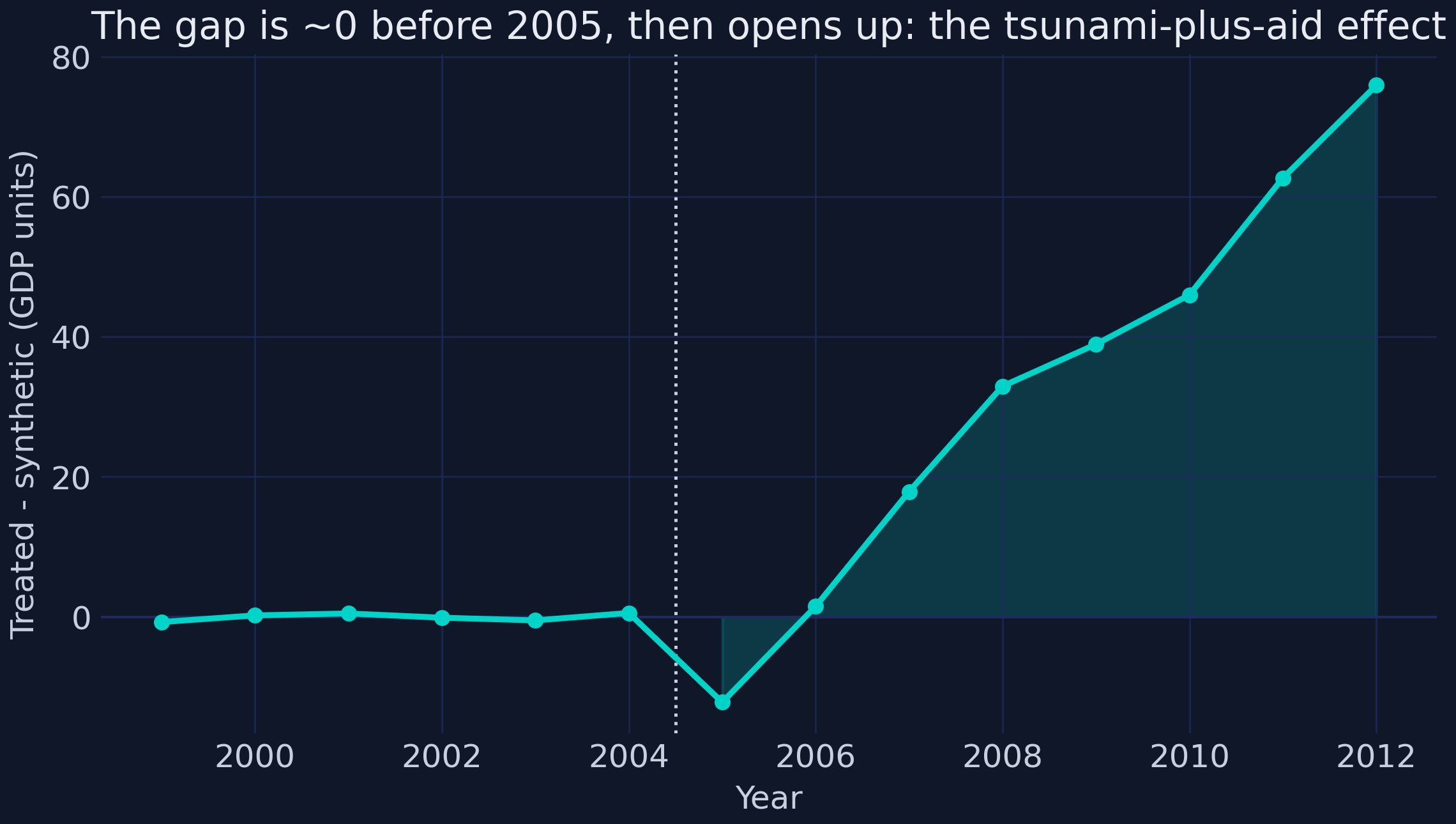
+18.3% above its no-tsunami twin by 2012 — and the gap opens only after the wave
The treated-minus-synthetic gap: indistinguishable from zero before 2005, then steadily positive.
DiD and synthetic control now agree: Aceh ended above its own trend.
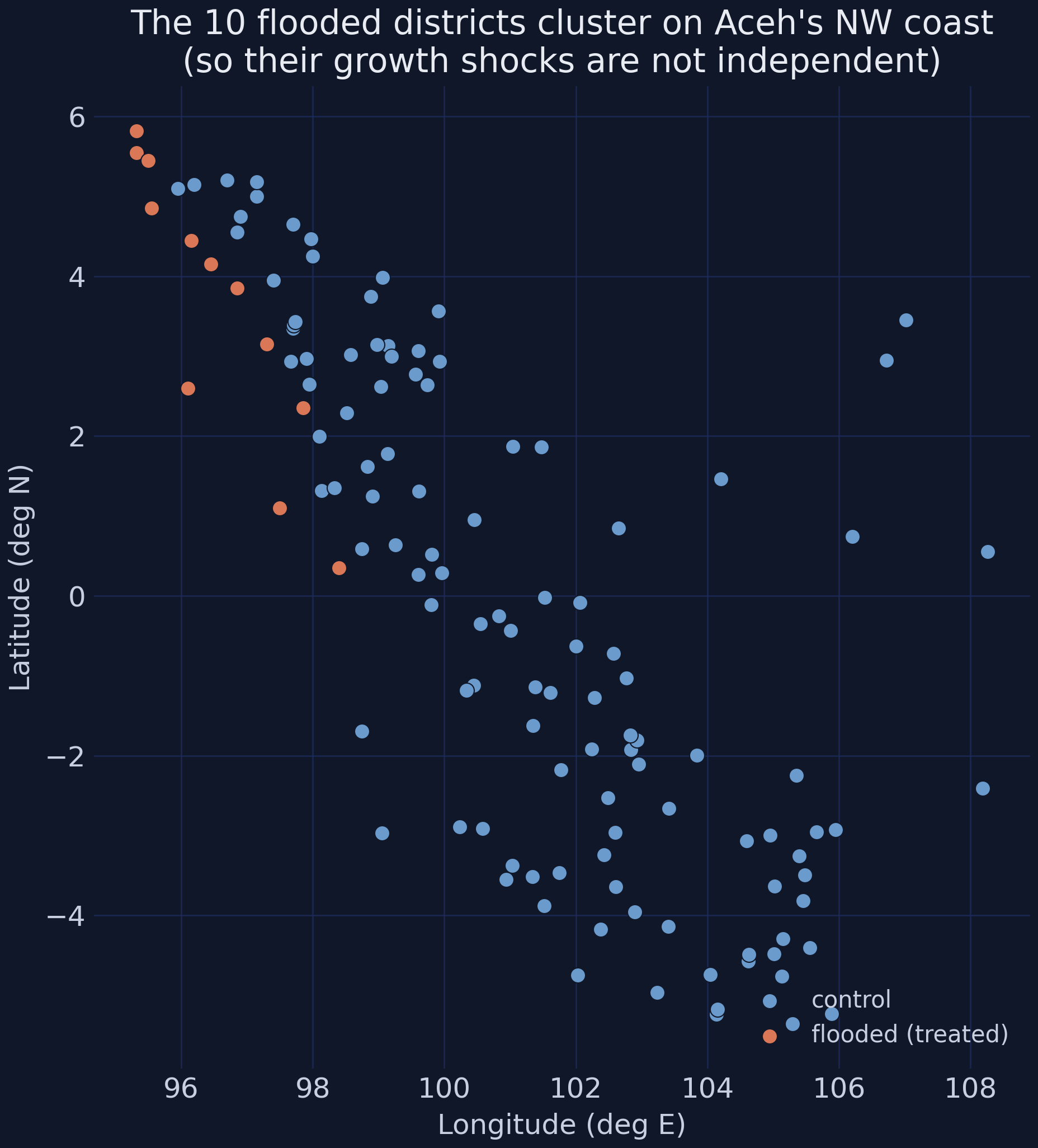
All 10 treated units sit in one corner of the map
Longitude–latitude scatter of every Sumatran district: the 10 flooded (treated) units, in orange, cluster on Aceh’s far north-west coast.
Near things are more related than distant things — their growth shocks are not independent draws.
The point estimate never moved — only our honesty about it did
Moran’s I on the residuals is +0.065 (permutation p = 0.003): nearby districts’ growth is significantly correlated. The fix is a Conley spatial-HAC standard error.
Recovery effect
Estimate
Naive SE
Conley-HAC SE
t(HAC)
2006–08
+0.0628
0.0146
0.0244
+2.57
Same +0.0628 in every column. The SE inflates \(1.68\times\) — downgrading a spurious *** to an honest **.
The Resolution
Act III
Four methods, one story: recovery beyond the counterfactual trend
DiD — −7.9% in 2005, +6.3 pp/yr in 2006–08, on a permanently higher path
Event study — flat pre-trend, sharp collapse, significant rebound
Night-lights — the dose-response: only the worst-hit quintile rebounds
Synthetic control — +18.3% above the no-tsunami Aceh by 2012
Triangulation, not a single regression, is what makes the claim credible.
Well-governed mega-reconstruction can bend a poor region’s path upward
Not “disasters are good” — 130,000 people died.
Aid \(\approx\)150% of damages · low-corruption agency · “built back better.”
That combination — not the wave — bent the path upward.
The strongest objection — and the answer
Objection. The data are synthetic, and there are only 10 treated districts — point estimates are fragile, standard errors wide.
Response.
Synthetic data are calibrated to the paper — audited column by column.
Small-N met head-on: flat pre-trend, null placebo, Conley-HAC errors.
Caveats narrow the claim — they don’t overturn it.
Five numbers to remember
Number
Value
2005 output shock
−0.0792***
2006–08 recovery premium (per year)
+0.0628**
Synthetic-control gap by 2012
+18.3%
Moran’s I (spatial autocorrelation)
+0.065
Recovery SE: naive → Conley-HAC
0.0146 → 0.0244
Five numbers, one story: a deep 2005 loss, a bigger recovery, honestly measured.
Well-governed reconstruction left a poor region on a permanently higher path.