Does working from home raise productivity — or do productive people just choose it?
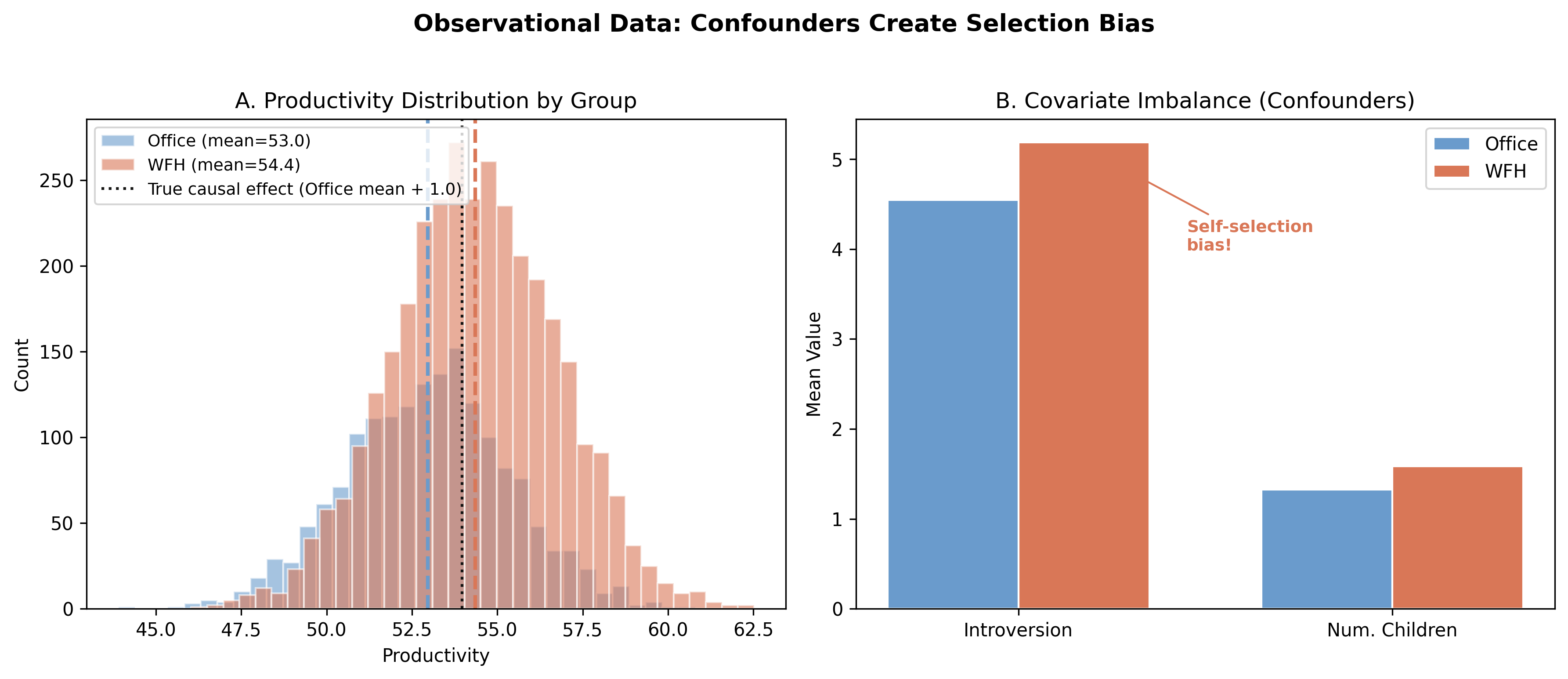
A company compares 5,000 employees and finds work-from-home staff are 1.39 points more productive.
But the true effect is only 1.0. Where did the extra 0.39 come from?
The naive comparison says +1.39 — confidently wrong by 39%
Panel A: WFH (orange) vs office (blue) productivity. Panel B: WFH workers are more introverted and have more children — the fingerprint of self-selection.
Where we’re going
The lab: 5,000 employees, a known ATE of 1.0, two confounders, one instrument
DoWhy’s four steps — Model, Identify, Estimate, Refute
Four estimators across two identification strategies
The lesson: identification and method comparison — not precision — separate causal from confidently wrong
The Investigation
Act II
We simulate the truth so we can check who recovers it
Outcome — productivity (mean 53.88), with a true WFH effect baked in at +1.0
Confounders — introversion and num_children drive both treatment and outcome
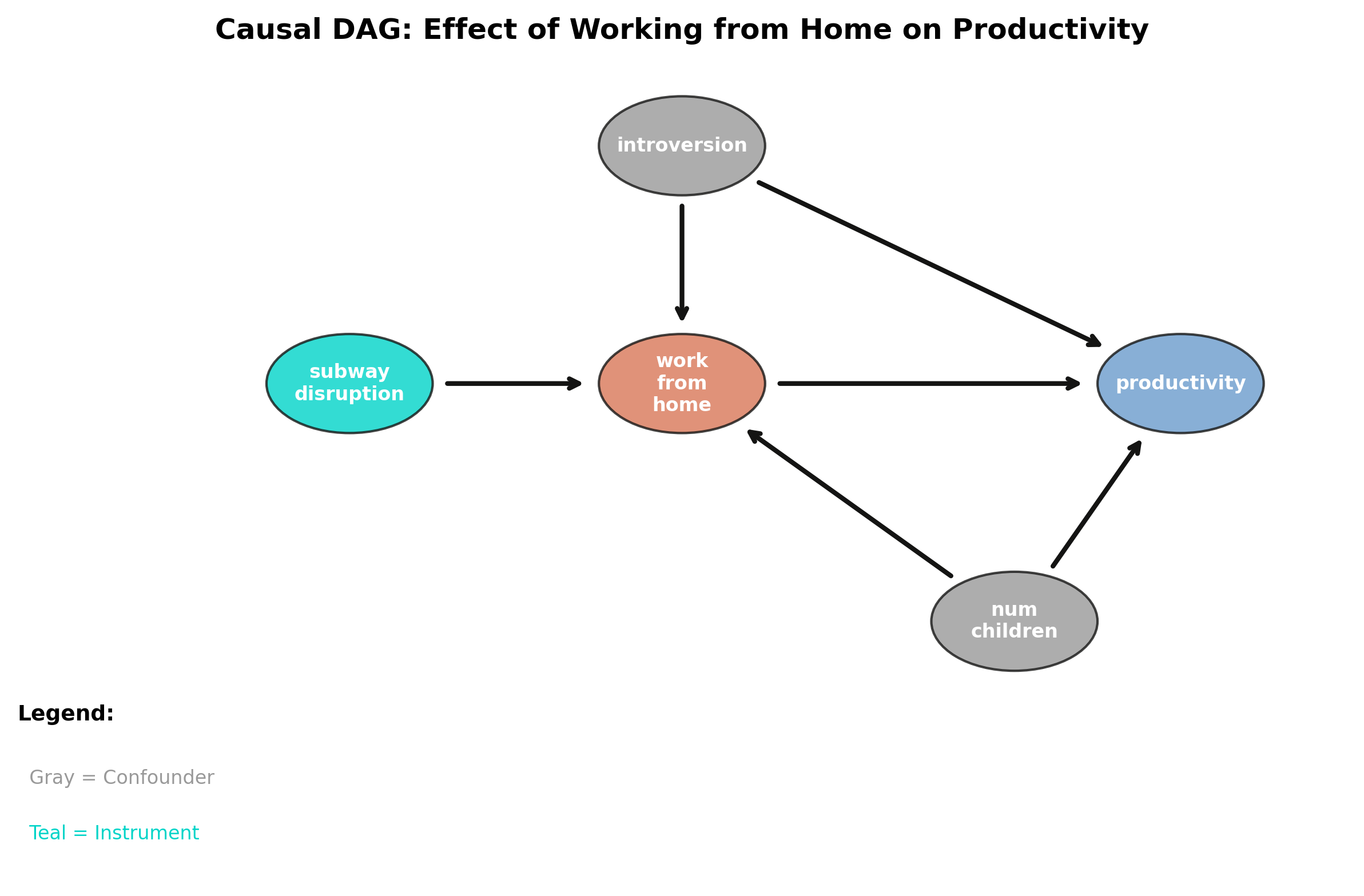
Instrument — subway_disruption shifts WFH but never touches productivity directly
The estimand is the average treatment effect (ATE) — and we know it equals 1.0, so every method is graded against the truth.
Confounders open a backdoor path the naive estimate can’t close
The DAG (DoWhy Step 1). Introversion and children point into both WFH and productivity — a backdoor path. Subway disruption points only into WFH: the makings of an instrument.
DoWhy forces four explicit steps — keeping assumptions apart from estimation
Step
Question
What you do
Model
What do I assume?
Draw the DAG
Identify
Is the effect computable?
Backdoor or IV
Estimate
What’s the number?
Regression, IPW, AIPW, IV
Refute
Is it robust?
Placebo, random cause, subset
Identification (a causal question about the graph) stays separate from estimation (a statistical question about the data).
Step 2 — Identify: the backdoor estimand conditions on the confounders
Combine an outcome model (\(\hat{\mu}_1,\hat{\mu}_0\)) with the IPW reweight. Consistent if either model is right.
AIPW gives 1.0115 (SE 0.0623) — smallest bias of the four, precision matching regression.
Step 3 — Estimate: IV survives unmeasured confounders, but pays in noise
estimate_iv = model.estimate_effect( identified_estimand, method_name="iv.instrumental_variable", method_params={"iv_instrument_name": "subway_disruption"},) # first-stage F = 293 (strong) · ATE 0.8881 · SE 0.3303
The instrument is strong (F = 293), yet the Wald ratio amplifies noise — SE 0.3303, more than \(5\times\) regression’s.
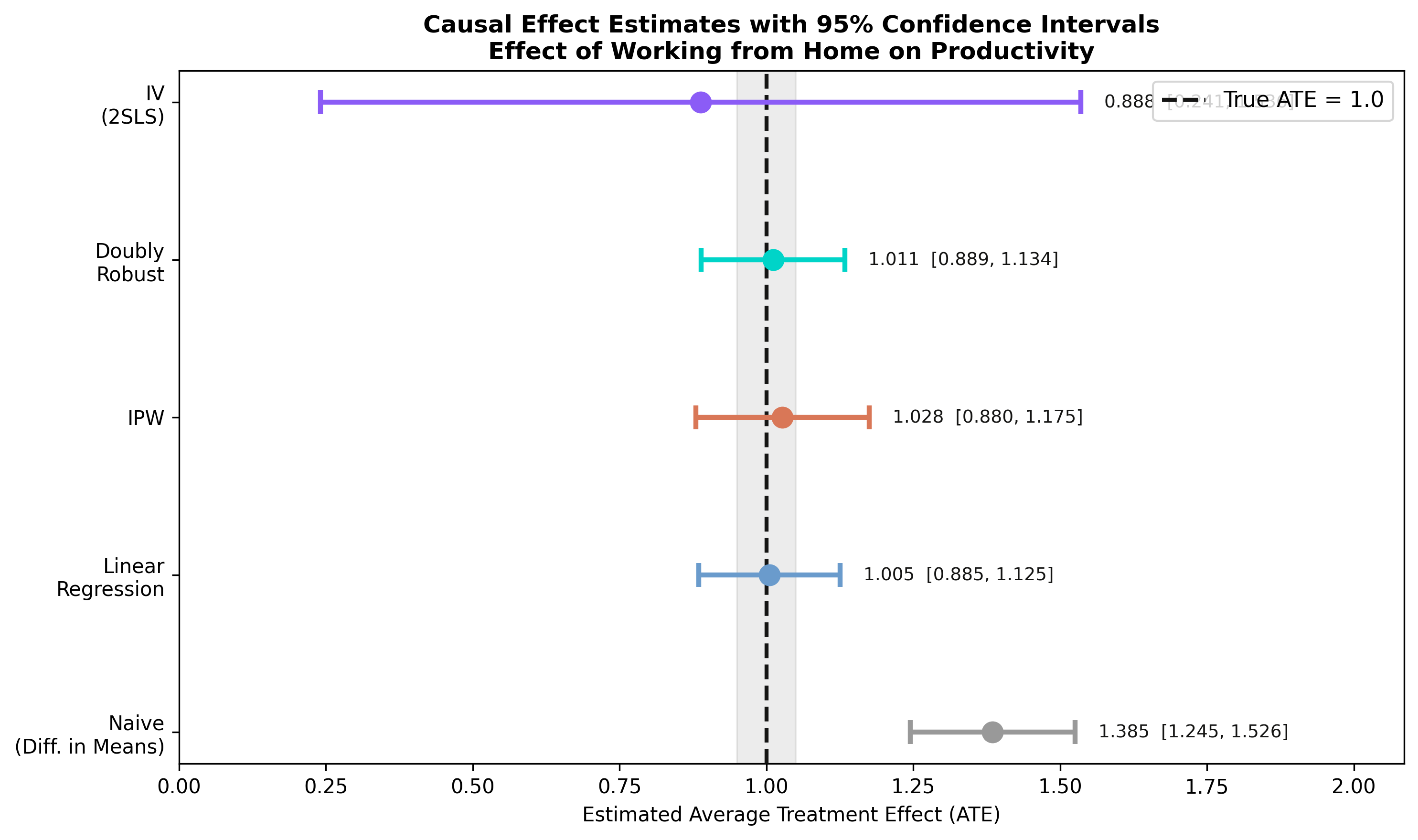
All four causal methods land near 1.0; the naive estimate misses entirely
Point estimates with 95% CIs against the true ATE (dashed). Naive overshoots; backdoor trio is tight; IV is unbiased but wide.
A small standard error is not a good estimate — the naive one proves it
Method
\(\widehat{ATE}\)
Robust SE
Covers 1.0?
Naive
1.3853
0.0716
no
Regression
1.0051
0.0614
yes
IPW
1.0275
0.0754
yes
Doubly robust
1.0115
0.0623
yes
IV (2SLS)
0.8881
0.3303
yes
The naive CI [1.25, 1.53] is narrow — and excludes the truth. Precision without validity is worthless.
The Resolution
Act III
Doubly robust nails the known effect: 1.01 against a truth of 1.00
1.0115
\(\widehat{ATE}\), AIPW (SE 0.0623) · smallest bias of the four · matches the planted truth of 1.0
Step 4 — Refute: three stress tests, three passes
Refuter
Expected
New effect
Verdict
Placebo treatment
\(\approx 0\)
−0.00003
pass
Random common cause
\(\approx 1.0\)
1.005
pass
Data subset (80%)
\(\approx 1.0\)
0.999
pass
Permute the treatment and the effect collapses to zero; add a fake confounder or drop 20% of rows and it barely moves.
Do four estimators and passing refuters make it causal? No — assumptions still carry it
Objection. Running four estimators and passing refutation tests can’t manufacture identification.
Response. Correct. The ATE is identified only under unconfoundedness (backdoor) or the exclusion restriction (IV). DoWhy makes those assumptions explicit and stress-tests the estimate — it cannot prove them. Refuters catch fragility, not unmeasured confounders.
Declare your assumptions, compare your methods, then refute — that’s what makes it causal.