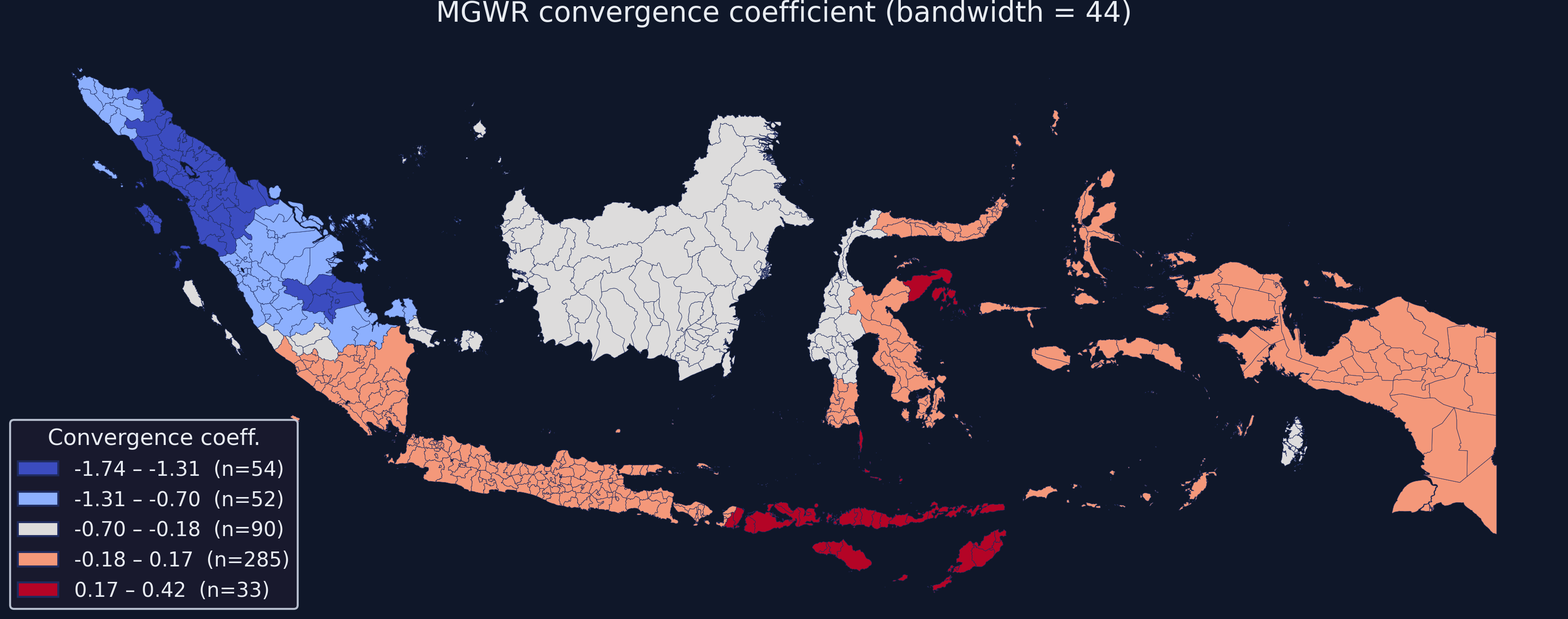
Catching-up is intense in western Sumatra, absent across most of the country
MGWR convergence-coefficient map. Deep blue (\(-1.74\)) = strong catching-up; light pink = no convergence.
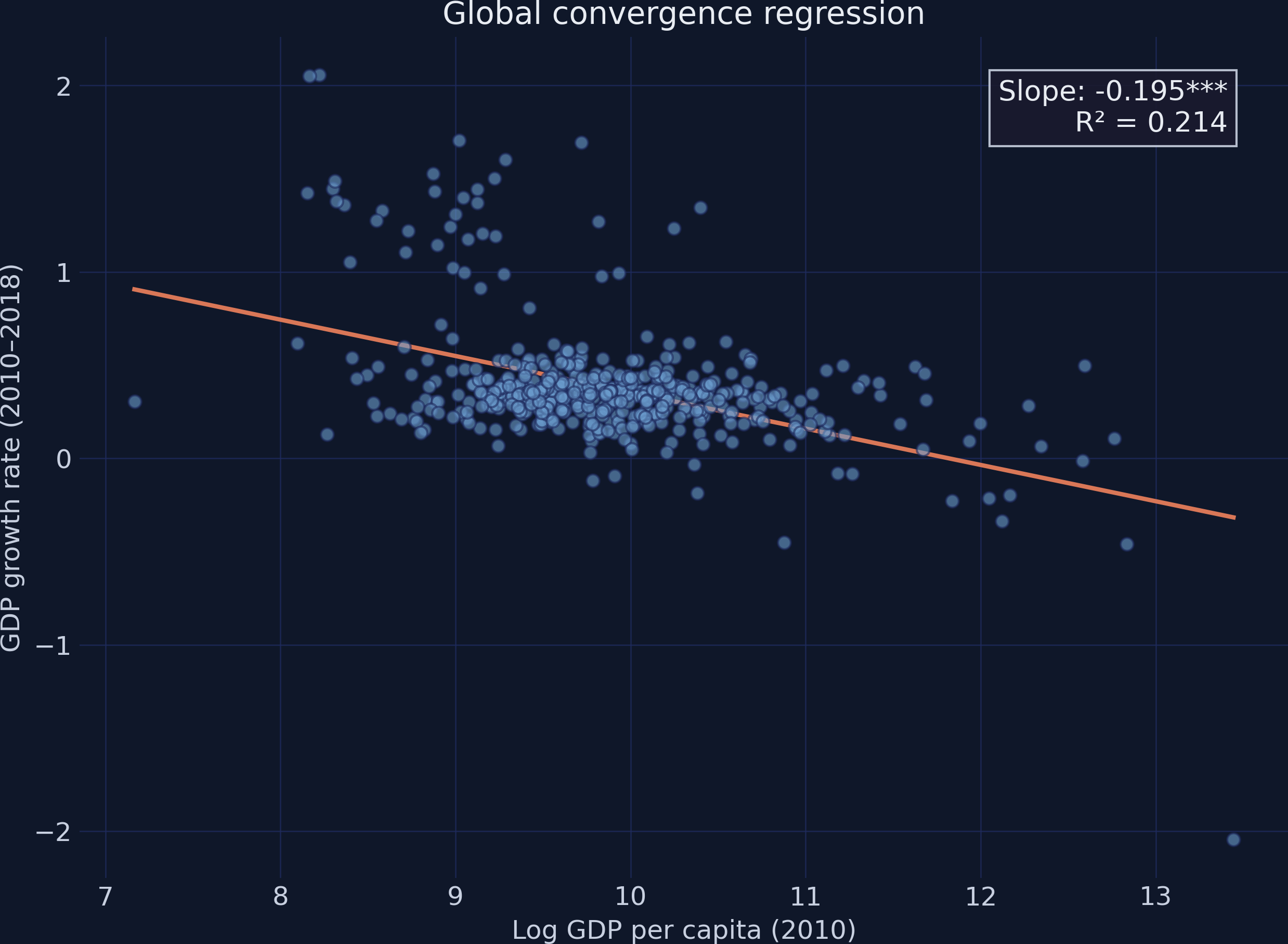
The local slope ranges from −1.74 to +0.42 — nowhere near a single −0.195
−1.74 → +0.42
range of the local convergence coefficient \(\hat\beta(u_i,v_i)\) · global OLS reports just \(-0.195\)
The Resolution
Act III
Going local triples the explained variance and slashes AICc by 500
Metric
Global OLS
MGWR
\(R^2\)
0.214
0.762
Adj. \(R^2\)
0.212
0.736
AICc
1341.25
838.41
Bandwidth
all (514)
44
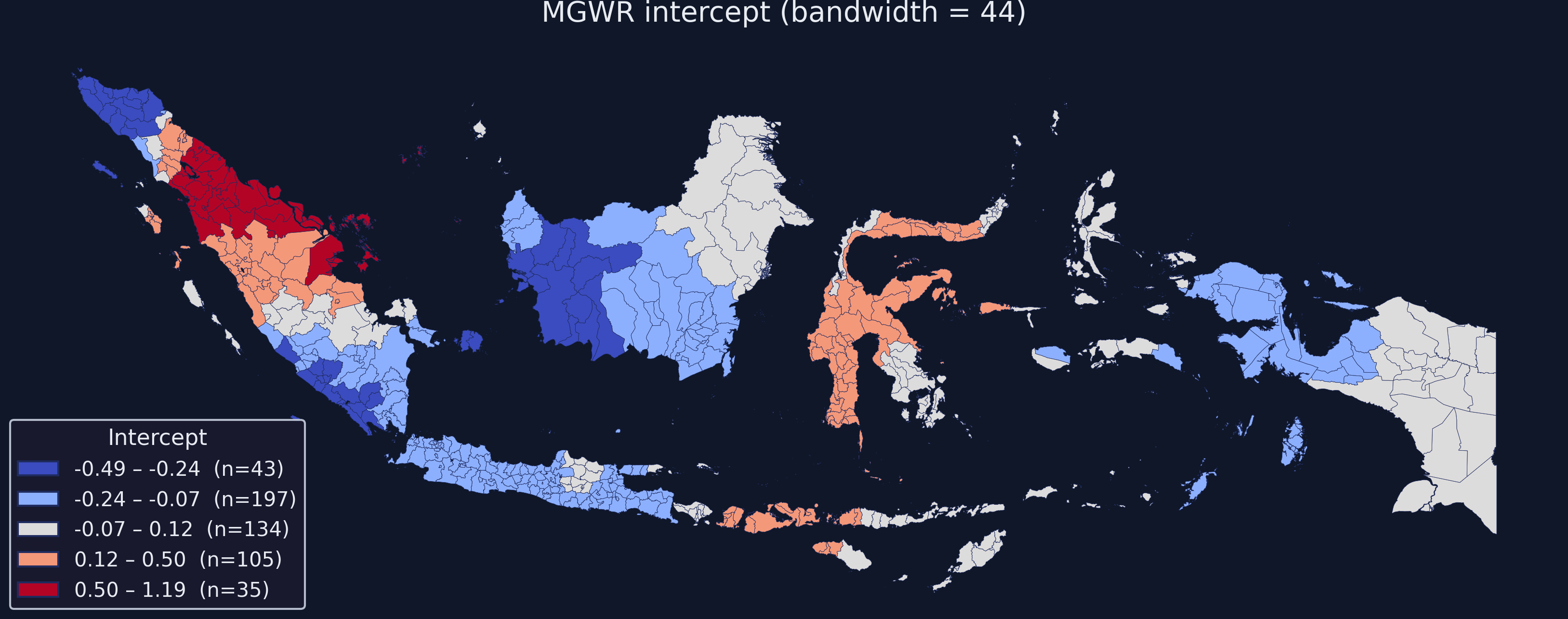
Adjusted \(R^2\) of 0.736 already nets out the 52 effective parameters — the gain is real, not overfitting.
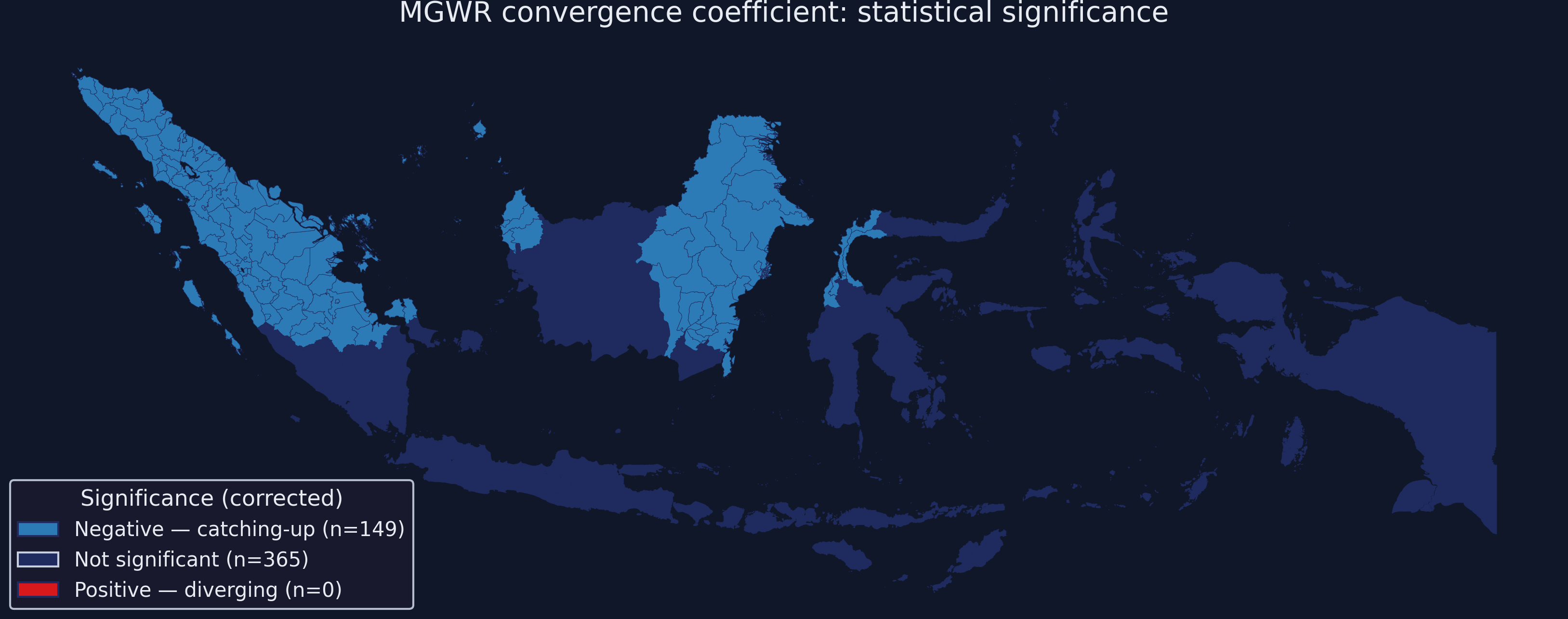
Only 149 of 514 districts truly converge — and none diverge
Significance map: blue = significant catching-up (149 districts), grey = not significant (365), no significant divergence.
Indonesia’s apparent national convergence is concentrated in 29% of districts
29%
of districts (149 / 514) show statistically significant catching-up — the rest are flat
Did MGWR just overfit its way to a high R²? No
Objection. A model with 52 effective parameters can always beat a 2-parameter line on \(R^2\).
Response. The adjusted\(R^2\) (0.736) already penalizes those parameters, and AICc — which explicitly penalizes complexity — falls by over 500. The bandwidth of 44 is data-selected, not tuned to inflate fit. The gain reflects genuine spatial structure, not flexibility.
MGWR does not identify causes — it maps where a relationship lives
Objection. Does a high local \(\beta\) prove poorer districts caused faster growth there?
Response. No. MGWR is descriptive: it shows where the income–growth association is strong, not why. The bivariate model omits human capital, infrastructure, and institutions — extending it is the natural next step.
Let geography, not a single national coefficient, tell you where catching-up happens.