Union members earn 18% more — but is that the union, or who joins it?
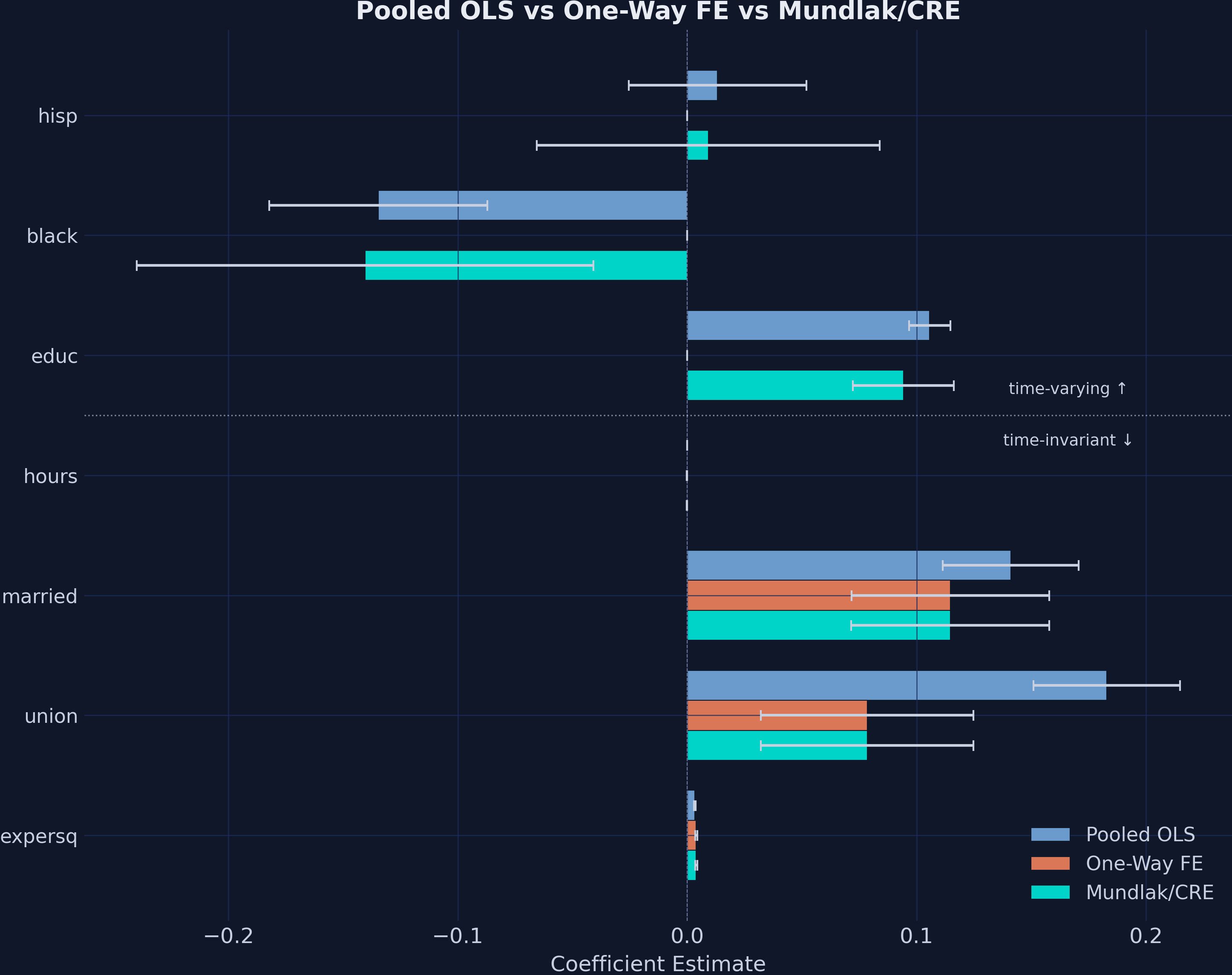
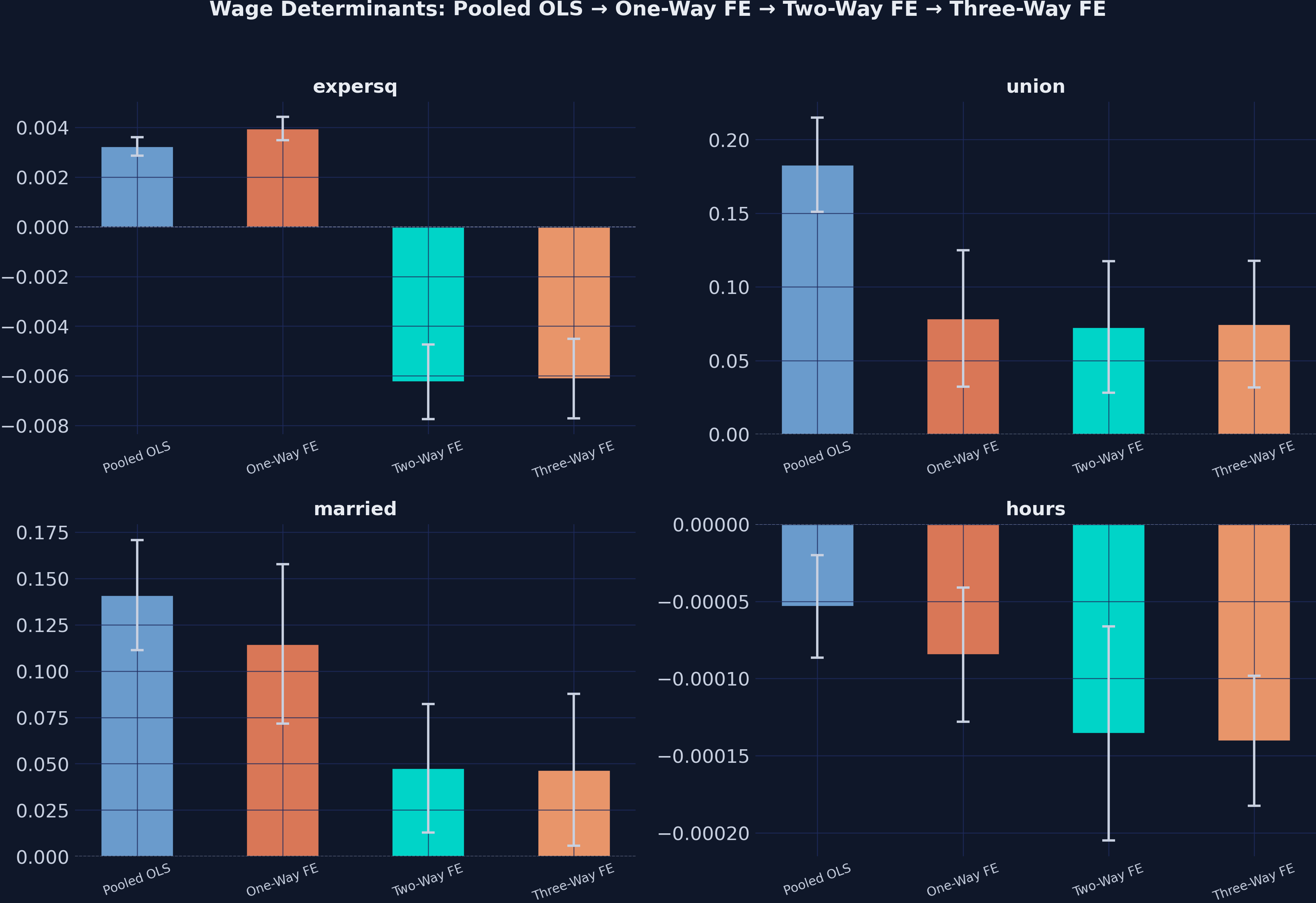
A simple regression says union-covered workers earn 18.3% more per hour.
But the workers who join unions may also be more able, more motivated, or sorted into better firms. How much of that 18% is the union — and how much is selection?
One control — worker fixed effects — cuts the union premium nearly in half
Pooled OLS vs One-Way FE vs CRE across seven covariates. The union bar collapses once worker fixed effects are absorbed.
Where we’re going
Why unobserved group heterogeneity biases OLS
Fixed effects as demeaning — the within transformation
Two-way FE, clustered standard errors, and IV
A real wage panel: the union premium and the CRE/Mundlak recovery
Event studies: when standard TWFE breaks down
The Investigation
Act II
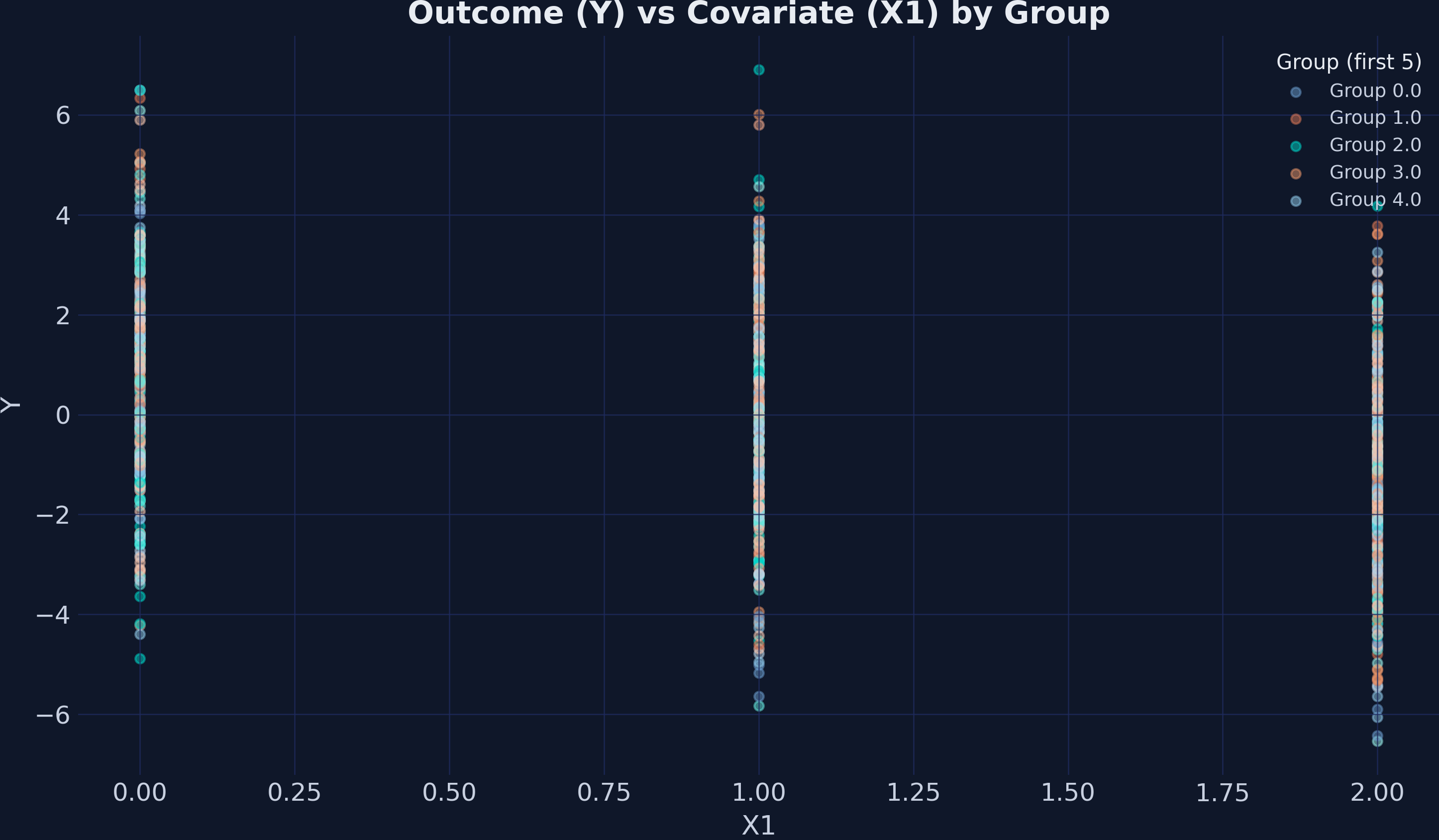
Groups sit at different levels — that between-group gap is the confounder
Outcome \(Y\) vs covariate \(X_1\), coloured by group. Clusters sit at different vertical levels.
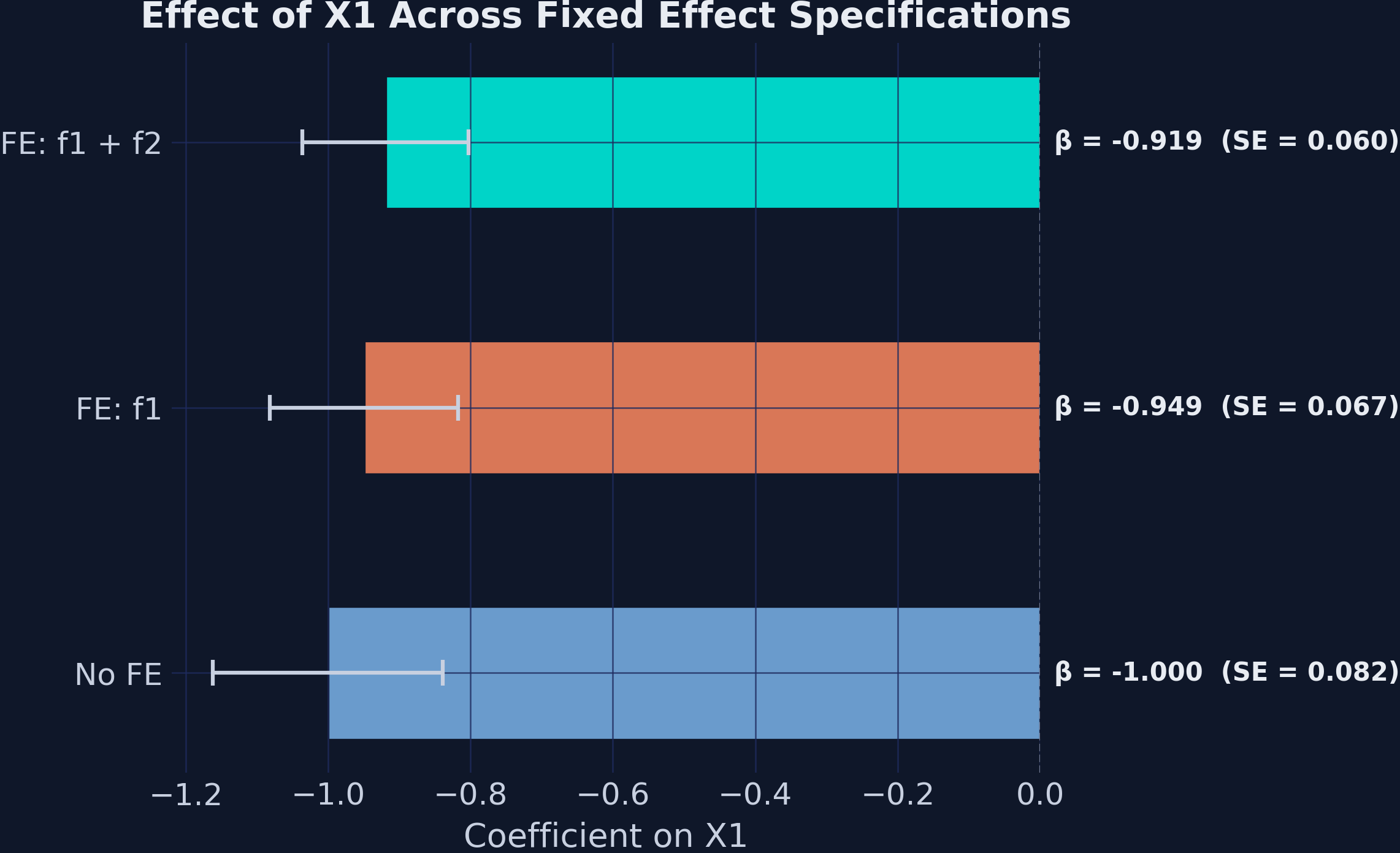
A fixed effect is just one extra intercept per group
\[Y_{it} = \alpha_i + X_{it}\beta + u_{it}\]
Add a unit-specific intercept \(\alpha_i\) that absorbs every time-invariant characteristic of unit \(i\) — observed or not.
Block one entire class of confounders — innate ability, firm culture, institutional quality — in a single step.
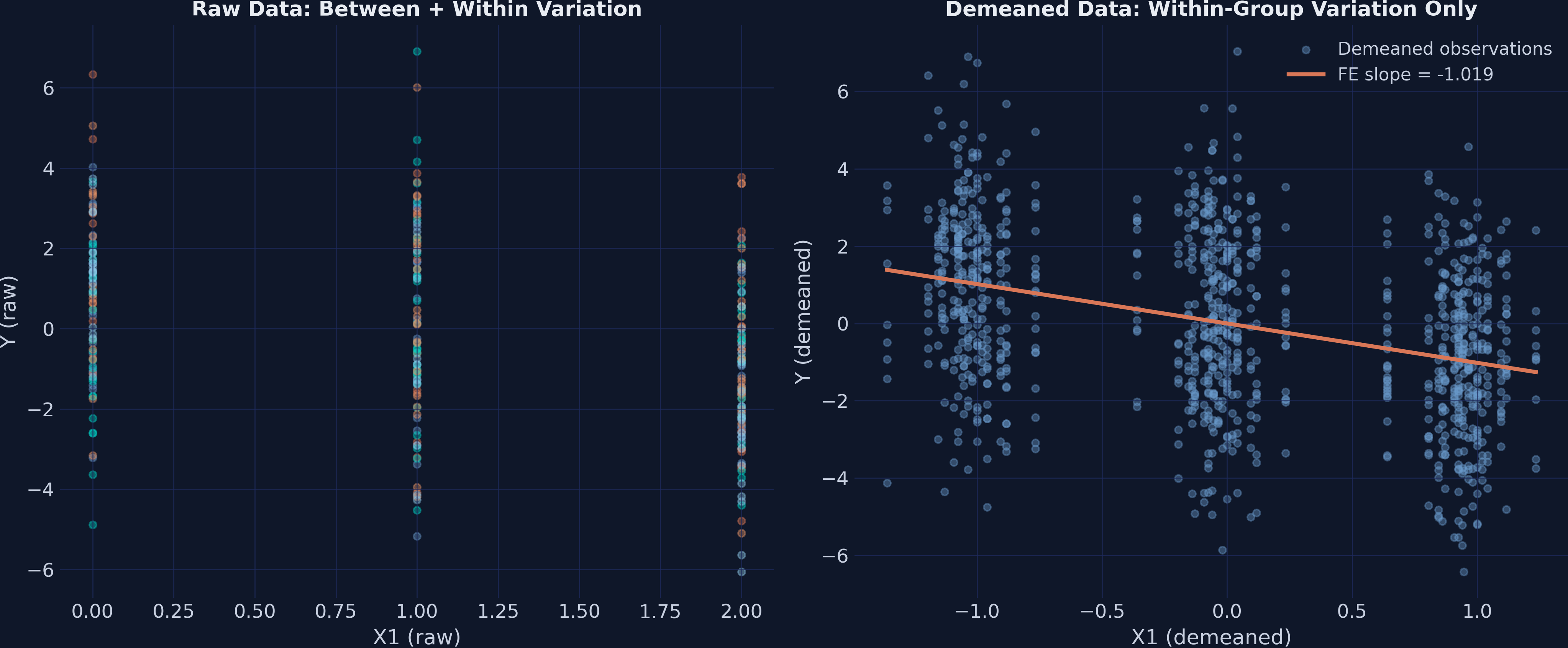
Absorbing group FE is mathematically identical to demeaning
Does FE make this causal? No — it removes one class of confounder, not all
Objection. Fixed effects look like a clean experiment — surely 7.8% is the causal union effect.
Response. FE only removes time-invariant confounders. A worker whose ability changes with union status, or reverse causality, still biases \(\hat\beta\). CRE adds an even stronger assumption. Identification rests on no time-varying confounding — not on the absorber itself.
Let the data’s within-group variation, not its levels, identify the effect.