We never see the Basque economy without the conflict
In 1970 the Basque Country entered decades of sustained terrorist activity. The natural question — what did it cost? — has no easy answer.
The path we observed is only half the story. The path without conflict — the counterfactual — was never recorded. How do you measure a road not taken?
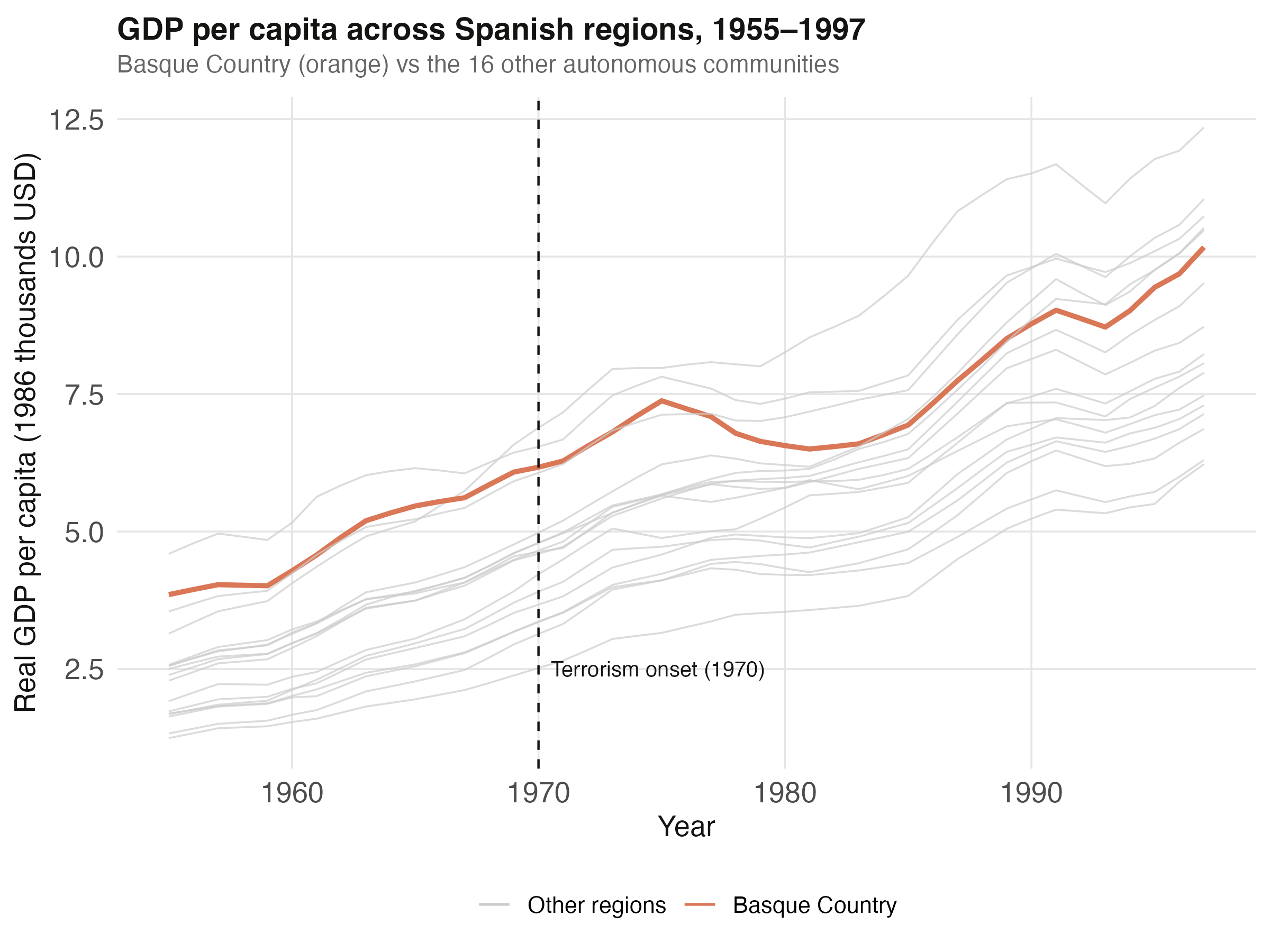
One treated region, no clean comparison — until we build one
GDP per capita across Spanish regions, 1955–1997. The Basque Country (orange) sits among the richest regions throughout — so no single region is a clean comparison.
Where we’re going
The single-treated-unit problem — why difference-in-differences breaks
The recipe: a weighted blend of donor regions matched on pre-1970 fit
The headline gap — actual minus synthetic Basque (the ATT)
Two falsification tests: a Catalonia placebo and an in-space placebo
The Investigation
Act II
The estimand is the ATT: the gap from the counterfactual we never see
\[\alpha_{1t} = Y_{1t} - Y_{1t}^{N}, \quad t \geq 1970\]
Treatment effect = actual GDP minus the no-conflict counterfactual \(Y_{1t}^{N}\).
The fundamental problem: \(Y_{1t}^{N}\) is never observed. Synthetic control estimates it as a weighted average of donor regions.
The estimator replaces the counterfactual with a weighted donor recipe
The optimizer keeps just 2 of 16 donors — a sparse, readable recipe
Diagnostic
Value
W weights sum to
1
Active donors (\(w > 0.01\))
2 of 16
Pre-treatment loss \(V\)
0.0089
Pre-treatment loss \(W\) (MSPE)
0.2467
Sparsity is typical: few donors resemble the treated unit, the rest get zero.
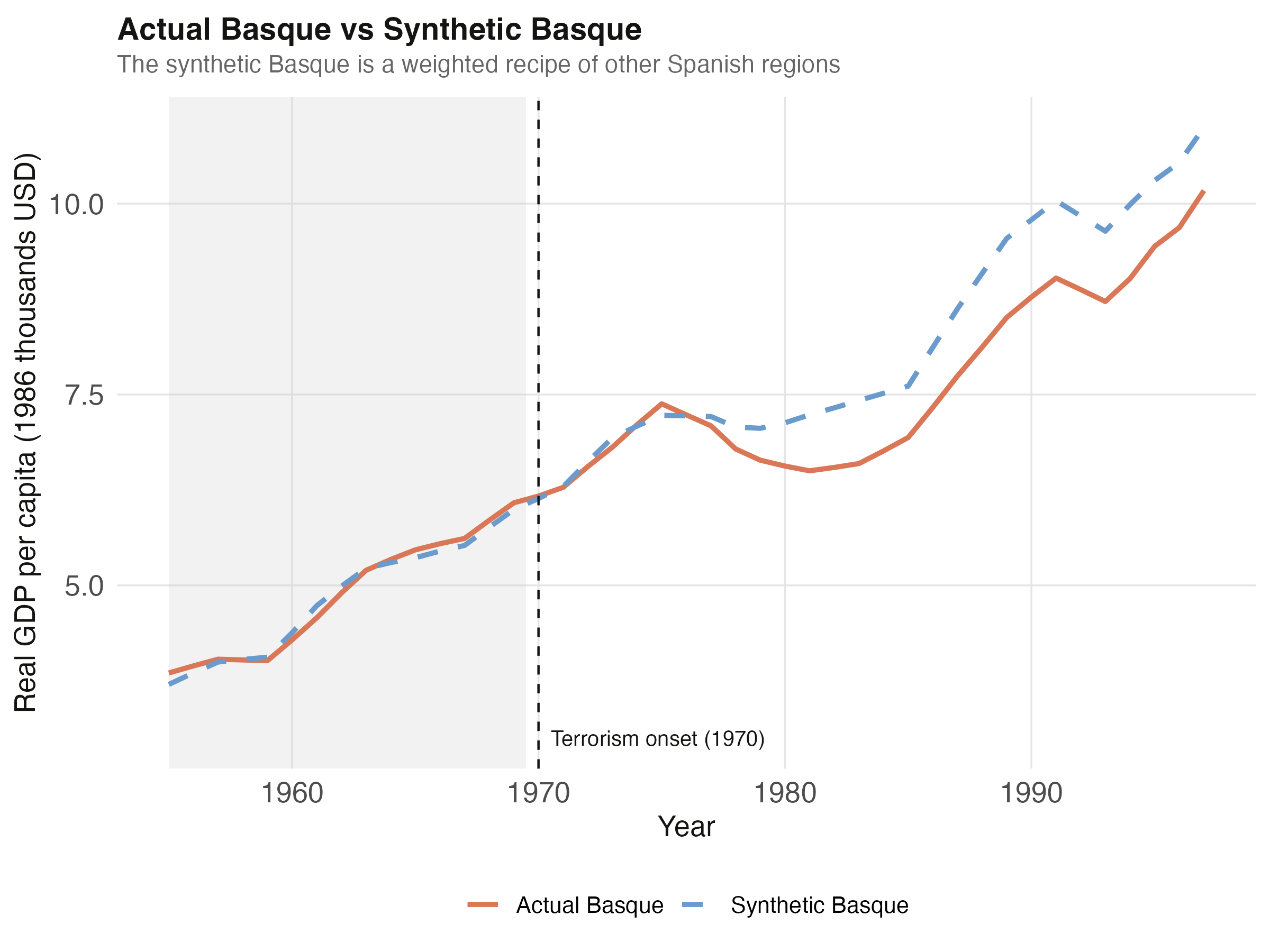
The synthetic Basque is 85% Catalonia and 15% Madrid
Region
Weight
Cataluna
0.851
Madrid (Comunidad De)
0.149
Every other region
0
Basque \(\approx\) 85% Catalonia + 15% Madrid — the only two comparably industrial, urban, wealthy regions.
The match is excellent where it matters — pre-1970 GDP and education
Predictor
Treated
Synthetic
Donor mean
Pre-1970 GDP/capita
5.28
5.27
3.58
School (primary) %
85.9
82.3
80.9
Industry share %
45.1
37.6
22.4
Agriculture share %
6.84
6.18
21.4
Pop. density 1969
247
196
99.4
Outcome-relevant predictors match closely; density is the largest gap.
The Resolution
Act III
Before 1970 the lines are one; after 1970 they split apart
Actual Basque (orange) vs synthetic Basque (blue dashed). Pre-treatment window 1955–1969 shaded; the vertical line marks conflict onset in 1970.
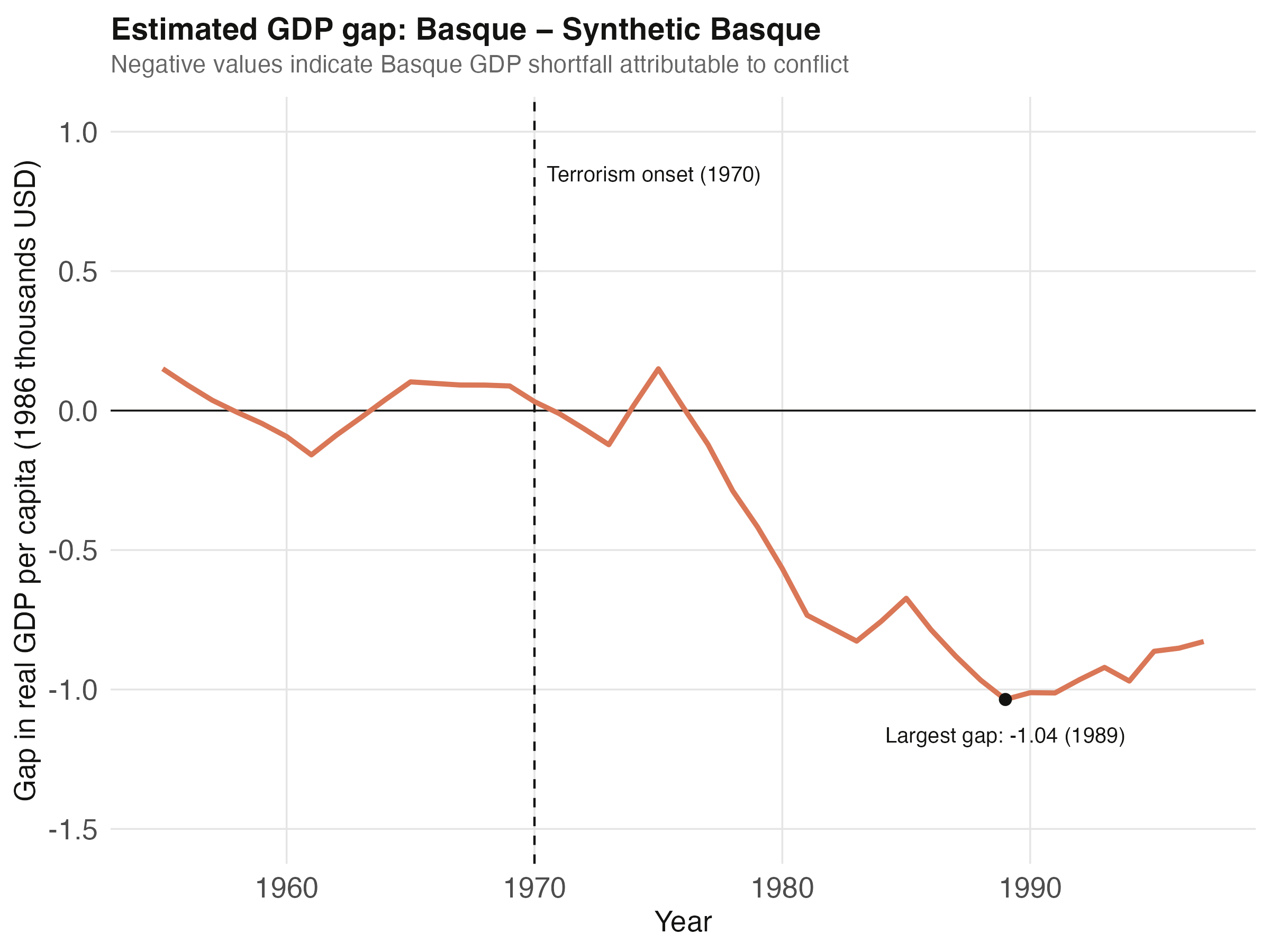
The gap is the cost — peaking at −1.04 thousand USD in 1989
Estimated GDP gap (Basque minus synthetic Basque). Essentially zero before 1970, then negative — the deepest deficit of −1.04 thousand USD falls in 1989.
The conflict cost the Basque Country −0.580 thousand USD per capita per year
−0.580
\(\widehat{\mathrm{ATT}}\), average 1970–1997 (thousand 1986 USD/capita) · roughly an 8% income shortfall
A single placebo isn’t enough — Catalonia’s ratio is nearly as big
Catalonia placebo
Value
Pre-1970 MSPE
0.006
Post-1970 MSPE
0.391
Post/pre ratio
64.7
Comparable to Basque’s own ratio of 60.1 — one placebo run has limited inferential power.
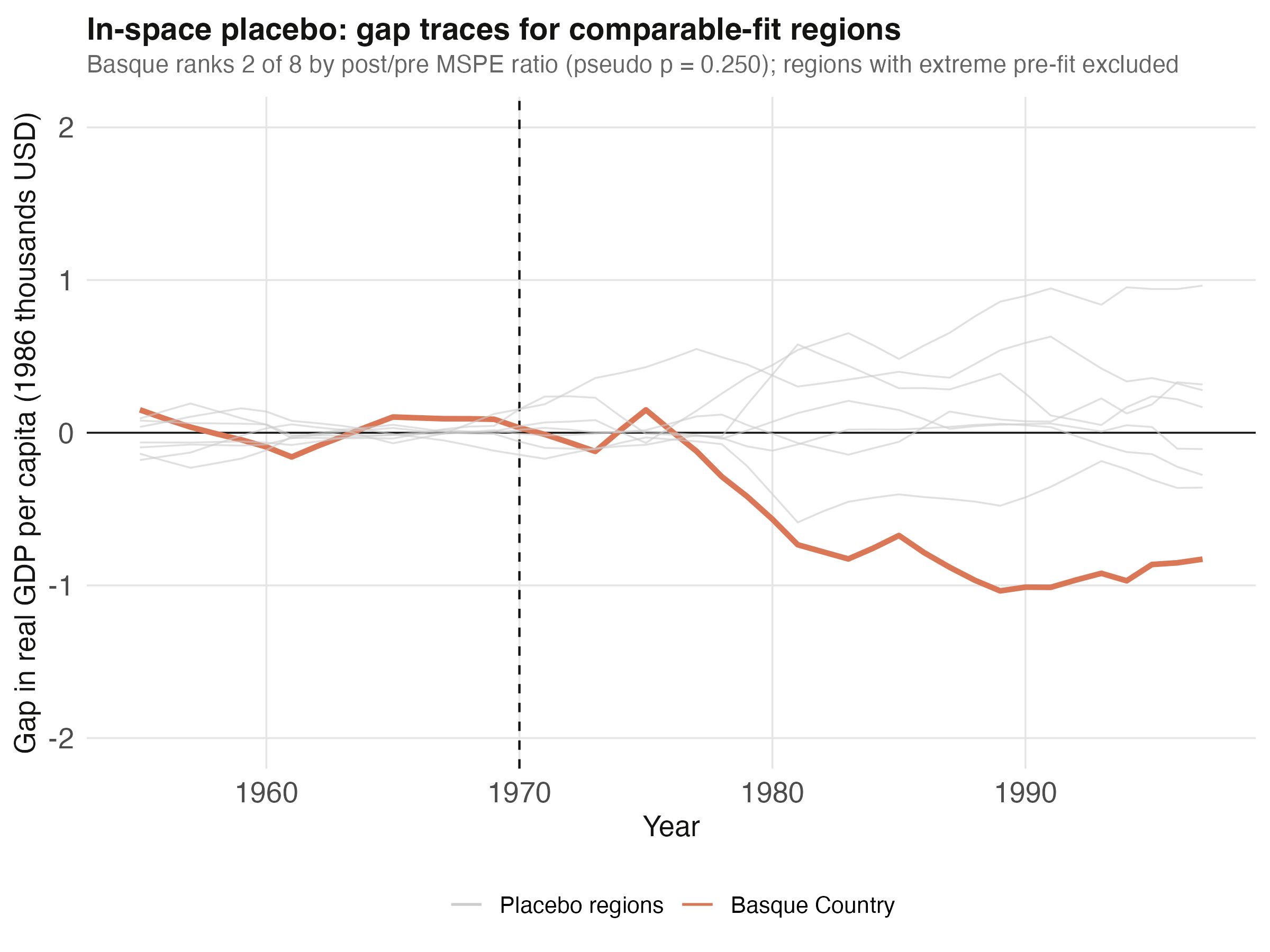
In the comparable-fit placebos, the Basque ranks 2 of 8
In-space placebo gap traces for the 8 comparable-fit regions. The Basque (orange) ranks 2 of 8 by post/pre MSPE ratio — at the loud edge of the chorus, not far outside it.
The placebo is suggestive, not decisive — read it with the donor weights
Objection. If Catalonia tops the placebo ranking and is also 85% of the synthetic recipe, isn’t the Basque “effect” just the same Spanish industrial transition?
Response. A fair caveat. When a synthetic is built from one dominant donor, that donor naturally scores high in its own placebo — it has no close substitute to rebuild it. The result is consistent with a sizeable cost (rank 2 of 8, an 8% shortfall) but the small 16-region pool limits resolution (smallest pseudo p = 0.125). Report placebo and donor weights together, not separately.
Match the pre-treatment, build the counterfactual, read the gap.