Two assumptions decide whether you trust the most-studied policy in econometrics
Prop 99 raised California’s cigarette tax 25 cents in 1988. The classic answer — a 25–30 pack drop — has been quoted for 20 years.
But it rests on two quiet assumptions: donor weights live on a sparse simplex, and donor states are unaffected by California’s policy. What if both are wrong?
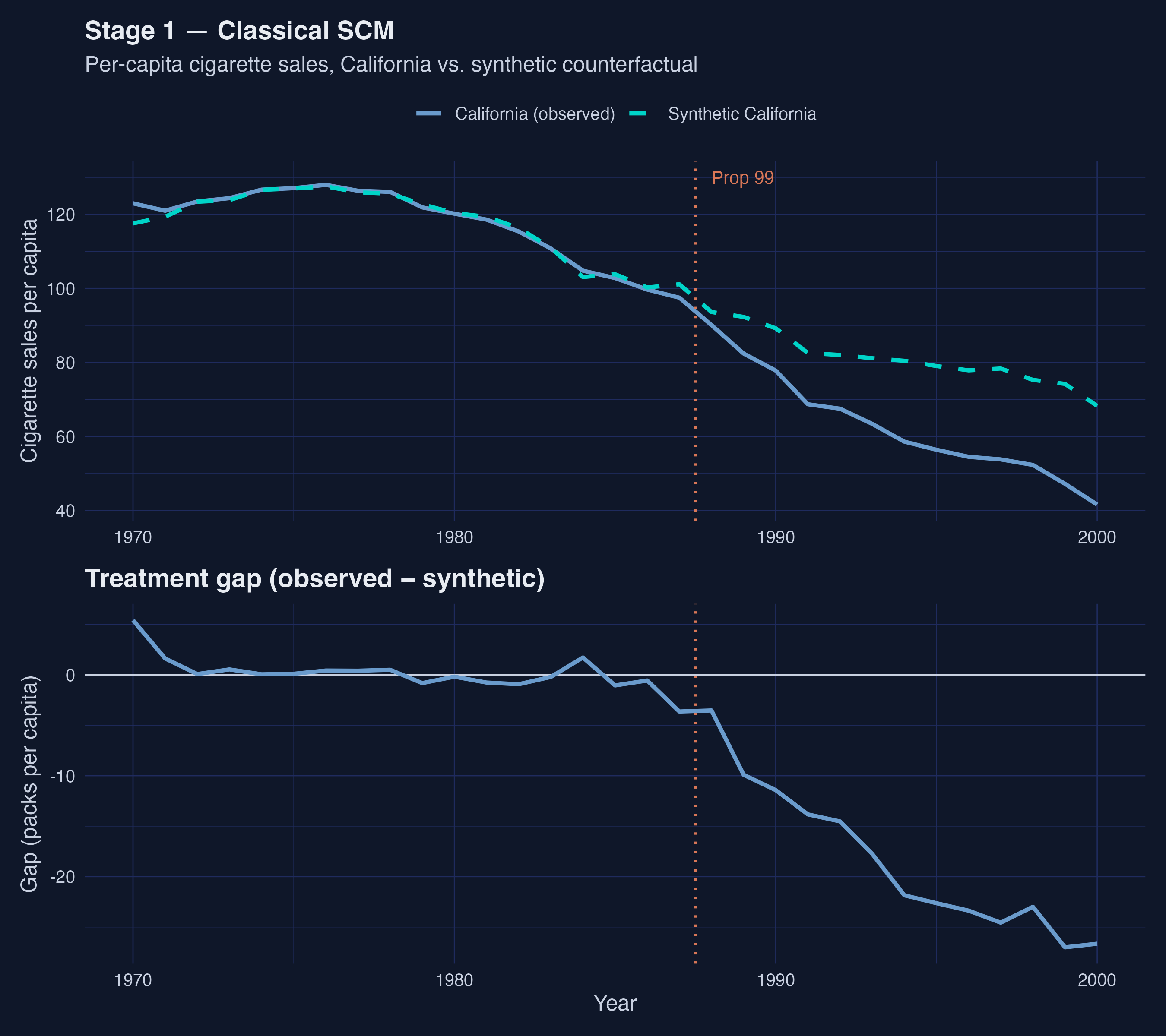
Same data, three estimators, one ATT — but the donor pool quadruples
ATT stays −18 to −16 packs/capita across all three estimators; active donors climb 4 → 23 → 27.
Where we’re going
The case: California, Prop 99, and the SUTVA problem
Three nested estimators — classical → horseshoe → spatial
The ATT (the estimand) and how its credible interval moves
The spillover that proves SUTVA is empirically false
The Investigation
Act II
The estimand is the ATT for one treated unit: California
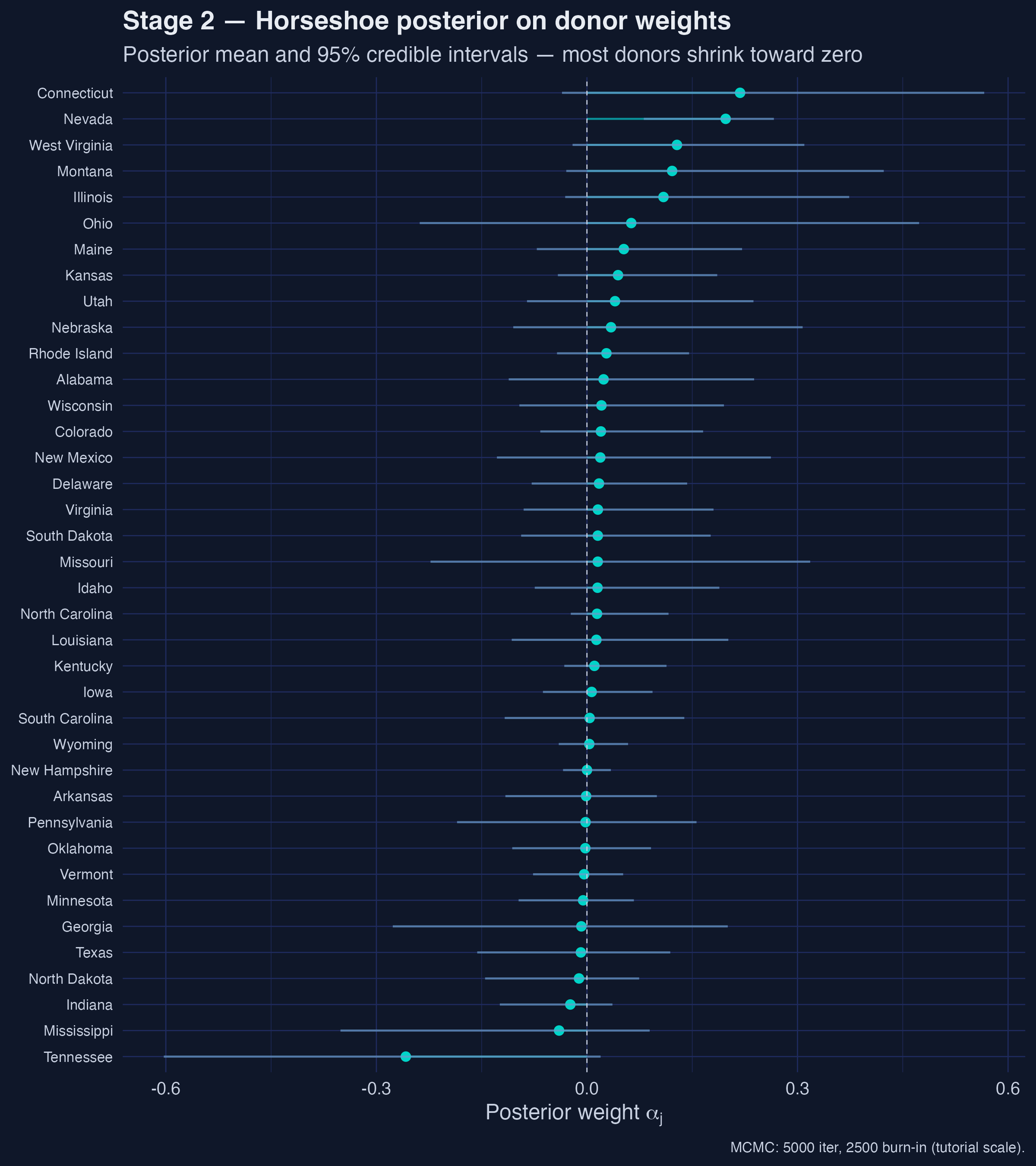
A global scale \(\tau\) pulls everything toward zero; a local scale \(\lambda_j\) lets individual donors break free. The half-Cauchy tails do the rest.
Now the data, not the constraint, decide which donors get non-zero mass.
Relax the simplex and the donor pool jumps from 4 to 23 active states
Posterior mean donor weights under the horseshoe, with 95% credible intervals — most hug zero, but only Nevada’s interval clears zero.
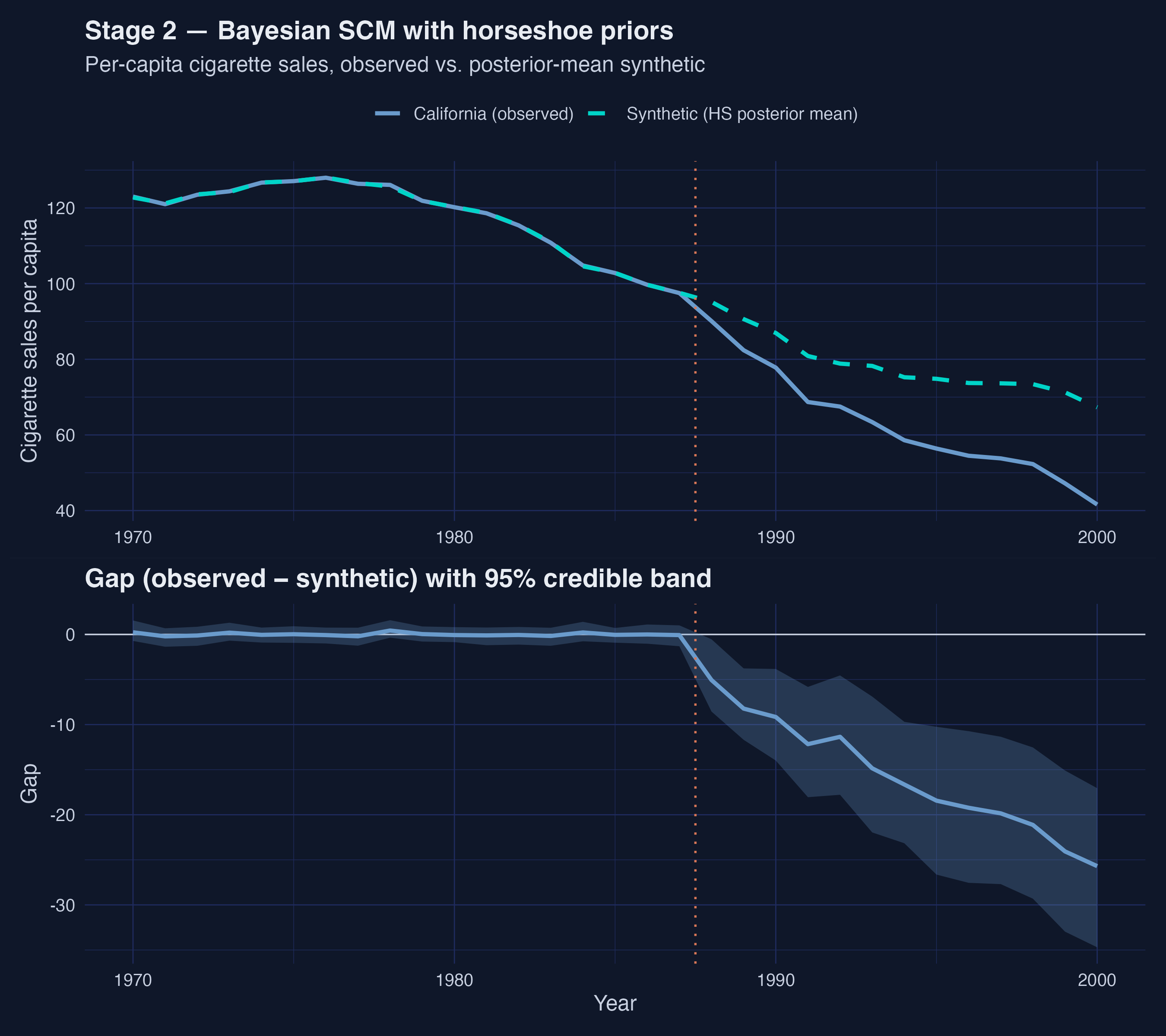
Propagating weight uncertainty widens the band but never reaches zero
California vs horseshoe-posterior-mean synthetic (top) and the gap with a 95% credible band (bottom) — the band widens post-1988 but stays below zero.
Drop SUTVA: each donor’s sales depend on its neighbours’ sales
The spatial lag \(W Y_{c,t}\) is the row-normalized neighbour average; \(\rho\) measures how strongly a state co-moves with its neighbours. When \(\rho = 0\) we recover Stage 2.
If \(\rho > 0\), a donor’s sales are partly its neighbours’ — so Nevada’s post-1988 sales are part of the treatment effect, not the counterfactual.
The Gibbs pipeline runs both MCMCs and the spillovers in one call
w <-as.matrix(california_smoking$w[, 2]) # CA's contiguity rowW <-as.matrix(california_smoking$W[, -1]) # 38x38 donor contiguityrownames(W) <-colnames(W) <- california_smoking$W$statefit_sar <-sc_spillover(data = panel_df, treated_unit ="California",w = w, W = W, y ="cigsale", X =c("retprice"),M = MCMC_ITER, burn = MCMC_BURN, seed = SEED) # horseshoe + SARrho_hat <- fit_sar$rho_hat # spatial autocorrelationatt_sar <- fit_sar$effects$ate_point # the ATT (estimand)att_sar_ci <- fit_sar$effects$ate_ci95 # posterior credible interval
The posterior puts spatial autocorrelation at rho = 0.223, clearly above zero
0.223
posterior mean \(\hat\rho\) (95% CrI [0.168, 0.272]) · moderate, stable, and bounded away from zero
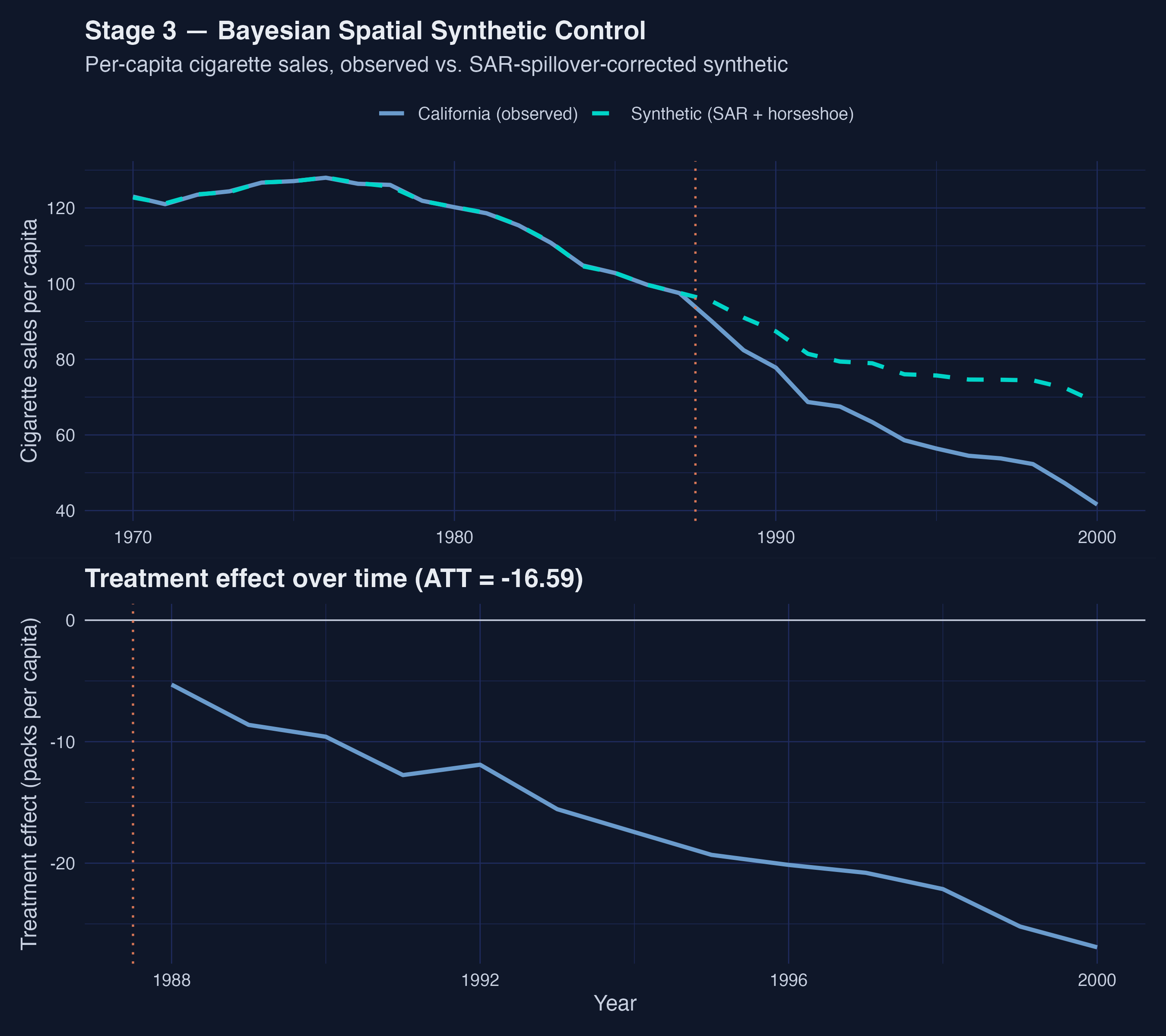
The posterior effect path widens linearly from −5 in 1988 to −27 by 2000
California observed vs SAR-corrected synthetic (top) and the treatment-effect path over time (bottom) — the effect on California deepens roughly linearly after 1988.
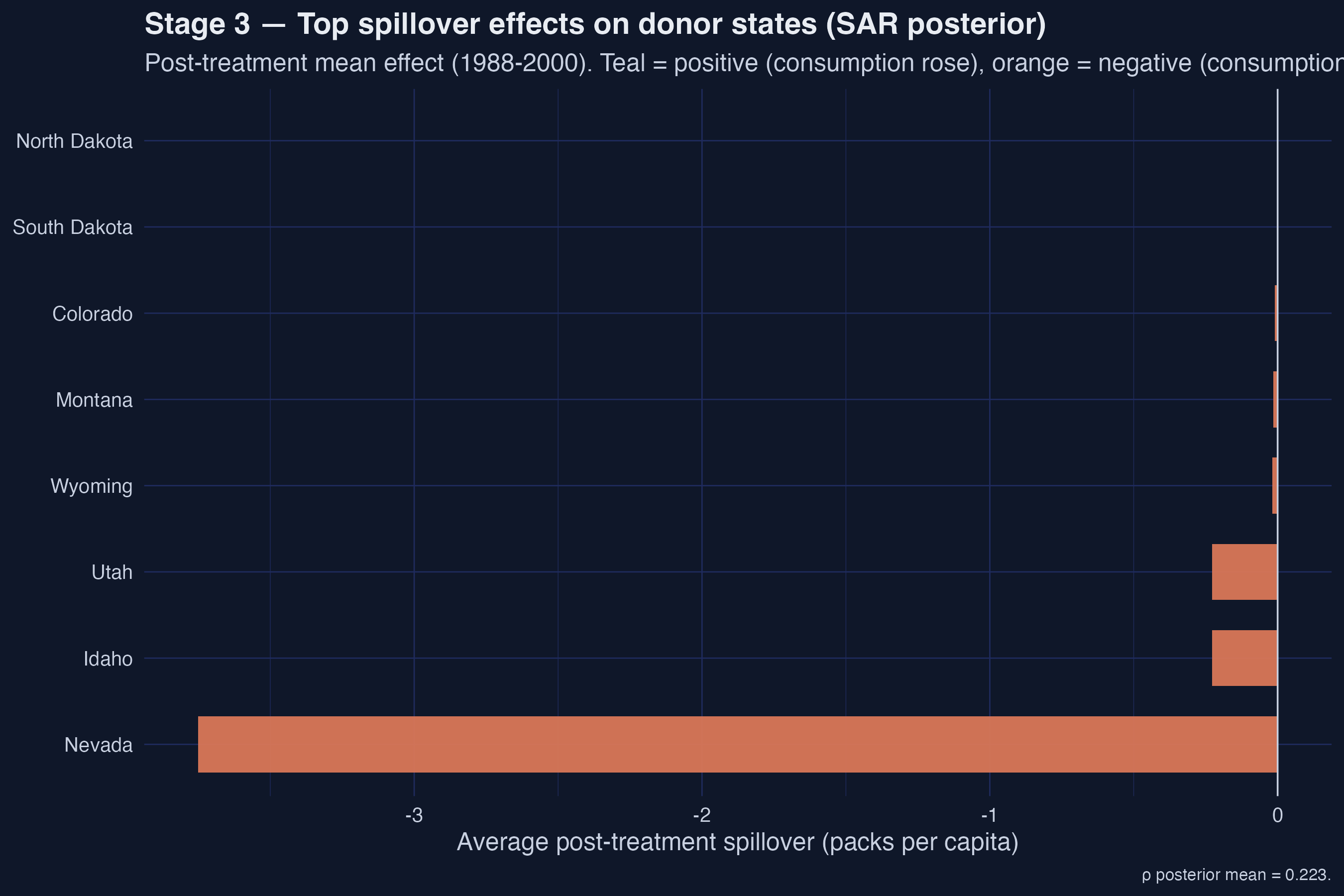
Almost the entire spillover lands on one state: Nevada
Top-8 donor states by absolute post-1988 spillover — Nevada’s −3.75 dwarfs every other state.
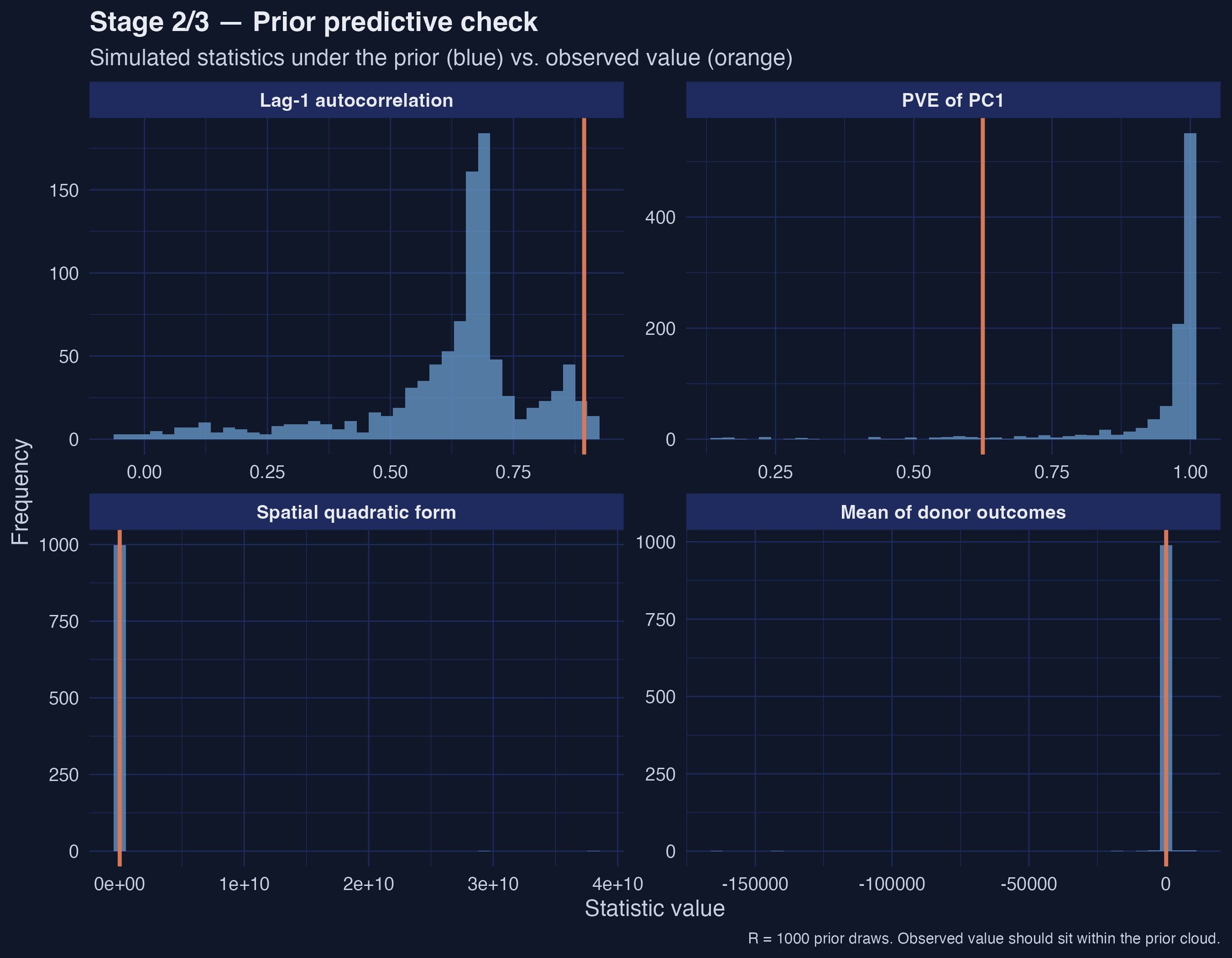
Before trusting the posterior, the prior must be compatible with the data
Prior predictive check on four summary statistics — all four observed orange lines land inside the simulated prior cloud, not in its tails.
The Resolution
Act III
All three estimators agree on sign and scale: Prop 99 worked
Stage
ATT
95% Interval
Active donors
Classical SCM
−18.46
[−22.21, −14.45]
4
Bayesian HS
−15.84
[−21.76, −9.48]
23
Bayesian Spatial SAR
−16.59
[−16.78, −16.39]
27
The headline ATT is robust; the donor pool’s shape is not — and the Stage-3 interval is artificially narrow (ESS(ρ) = 3 at tutorial scale).
Does the SAR layer make this causal? No — two assumptions still carry the weight
Objection. A spatial model and machine-selected controls can’t manufacture identification.
Response. Correct. The ATT is identified only under conditional independence given \(X\) and parallel trends. The horseshoe just selects controls flexibly; the SAR layer just tests SUTVA — and rejects it. We evaluate a method, not a naive causal claim.
SUTVA is empirically false here — and that widens Prop 99’s true reach
−3.75
Nevada’s post-treatment spillover (packs/capita) · 16× the next donor · direct evidence SUTVA is violated
Let the data, not the simplex, choose your donors — and let the map tell you who else was treated.