Richer countries have better institutions — but which way does the arrow point?
Stronger property-rights institutions track vastly higher income across countries. The slope is real and huge.
But correlation is not causation. Maybe rich countries simply afford better courts. Maybe geography or culture drives both. Which way does the arrow point?
A deadly natural experiment: where Europeans died, extractive institutions followed
Acemoglu, Johnson & Robinson (2001) use European settler mortality during colonization as an instrument for modern institutions.
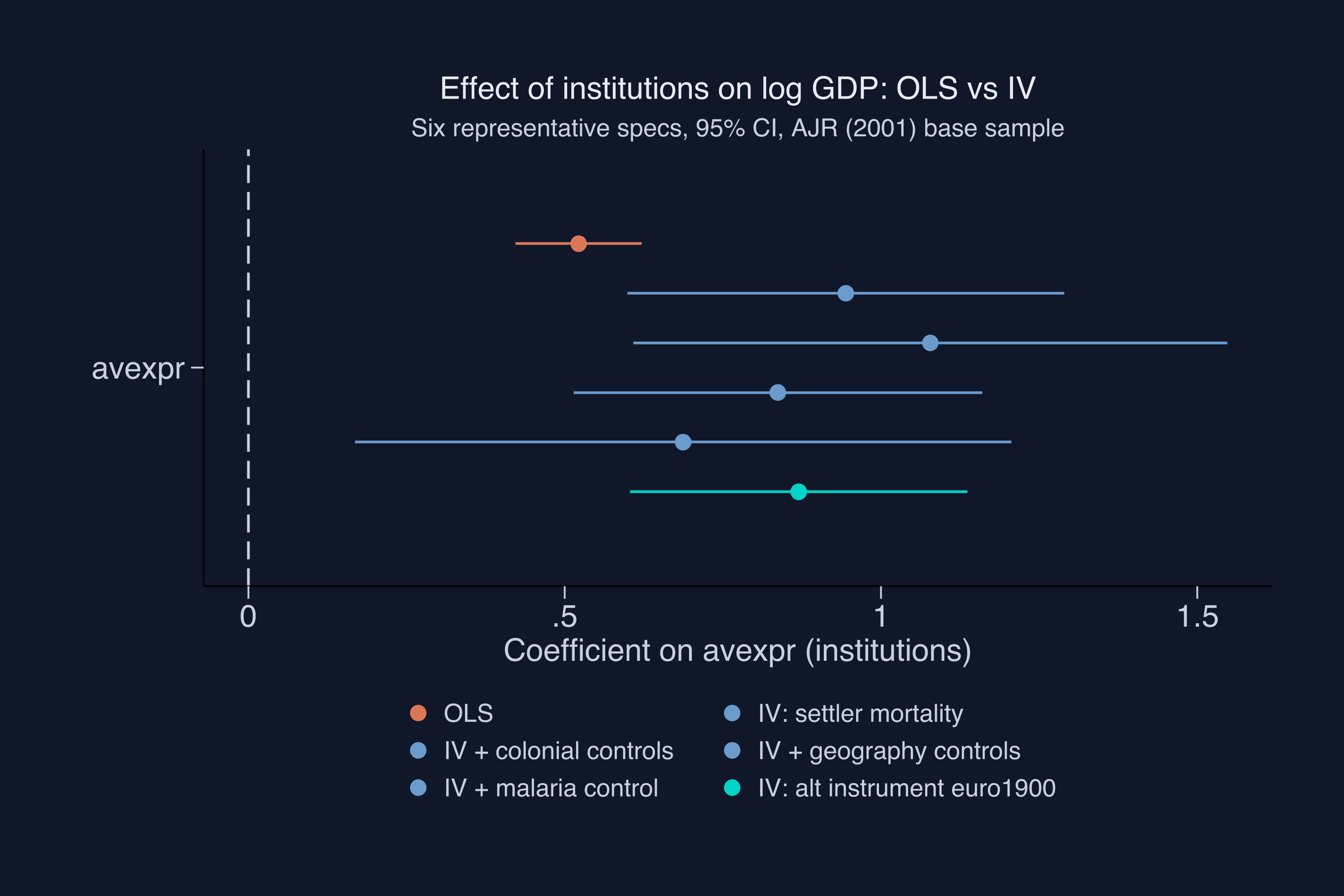
Five estimates, one dataset: OLS says 0.52, IV says 0.94
Coefficient on institutions across six specs — OLS (orange), four IV variants with settler mortality (steel), IV with an alternative instrument (teal). 95% CIs.
Where we’re going
The instrument: settler mortality across 64 ex-colonies
The three conditions an instrument must satisfy
2SLS = reduced form ÷ first stage
The headline: institutions raise GDP by 0.944 (a LATE)
Five families of robustness — and the one honest doubt
The Investigation
Act II
A regressor correlated with the error term makes OLS lie
\(Y\) is log GDP, \(X\) is institutional quality, \(U\) collects every unobserved driver of income. The non-zero covariance is exactly what biases OLS.
An instrument must clear three bars: relevance, exclusion, exogeneity
Stage 1 regresses \(X\) on \(Z\); stage 2 regresses \(Y\) on the predicted\(\hat X\). With one instrument, the IV estimate is just reduced form \(\div\) first stage.
OLS first: with zero controls, institutions “explain” a 0.522 slope
Sample
\(\hat\beta\) (avexpr)
SE
Sig. 1%?
Full (N=111)
0.532
0.029
yes
Base (N=64)
0.522
0.050
yes
+ continents
0.390
0.051
yes
This is the number the IV will stress-test — not one it generates.
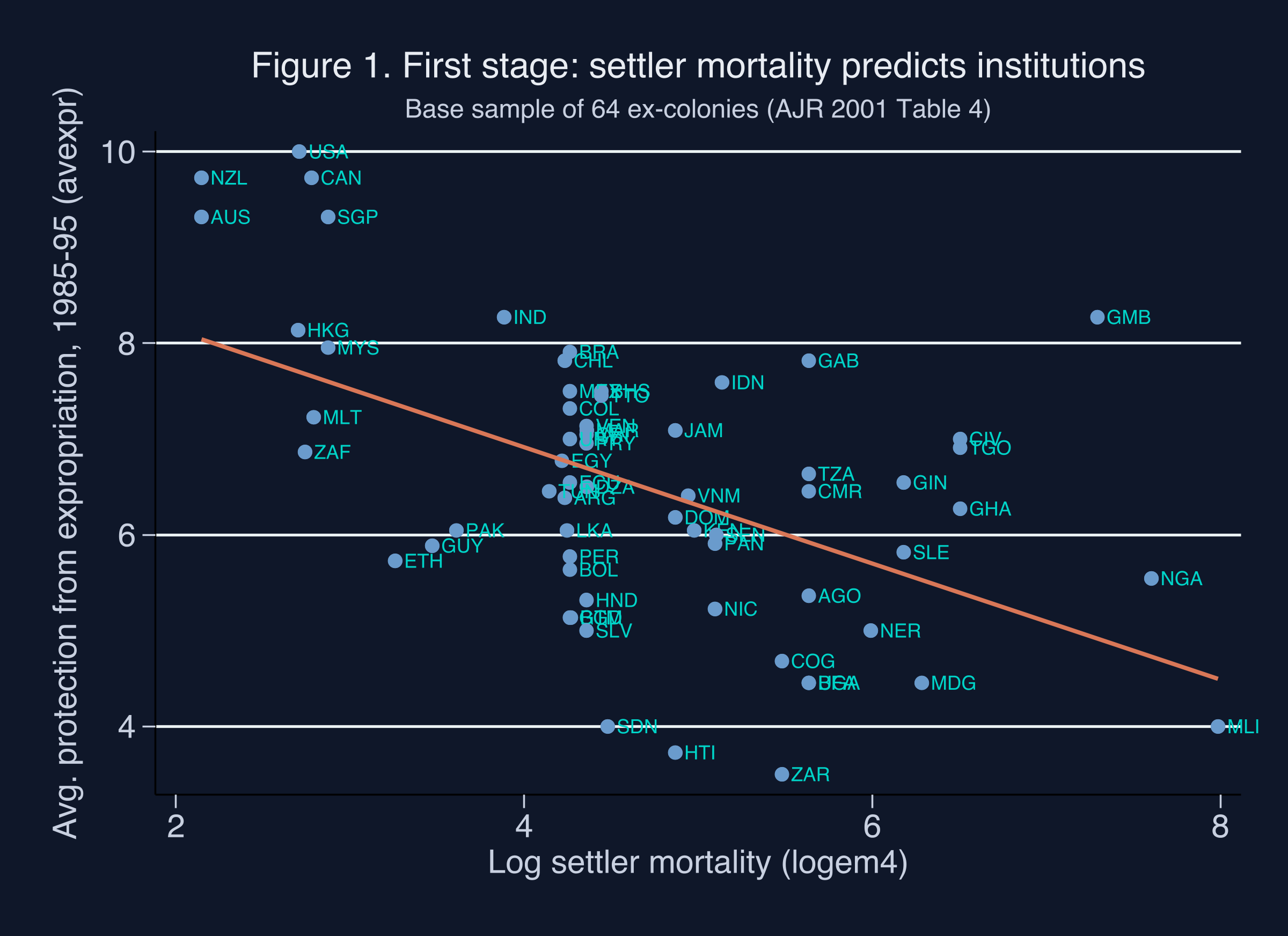
First stage: deadlier colonies inherited weaker institutions (slope −0.607)
Modern expropriation protection vs log settler mortality, 64 ex-colonies. Slope \(= -0.607\), \(F = 16.32\), \(R^2 = 0.27\).
Is the instrument strong enough? F = 16.32 — passing, but barely
Diagnostic
Value
Threshold
Kleibergen-Paap rk Wald F
16.32
10 (rule of thumb)
Stock-Yogo 10% max IV size
—
16.38 (iid)
Anderson-Rubin Wald (robust)
61.66
\(p < 0.0001\)
Borderline on the conventional threshold; the weak-IV-robust AR test reassures.
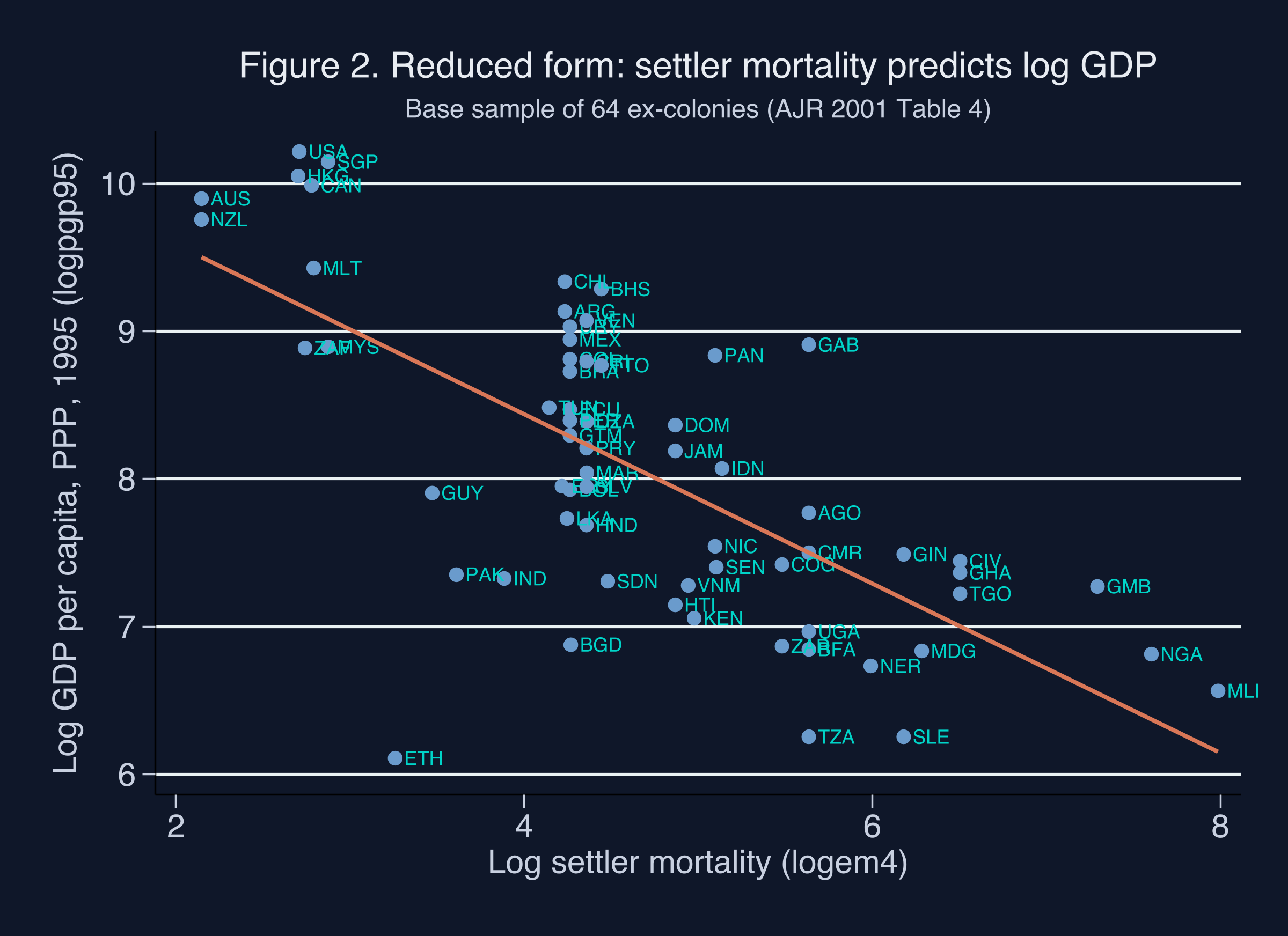
Reduced form: the instrument’s total reach on income is steep
Log GDP per capita (1995, PPP) vs log settler mortality, 64 ex-colonies. Slope \(\approx -0.573\).
Six lines of Stata estimate the whole IV
use"maketable4.dta", clearkeepif baseco==1ivreg2 logpgp95 (avexpr = logem4), ///robust first endog(avexpr)
(avexpr = logem4) declares the endogenous regressor and its instrument; endog() runs the Durbin-Wu-Hausman test.
The Resolution
Act III
Instruments raise the institutional effect to 0.944
0.944
2SLS coefficient on institutions (robust SE 0.176) · 81% larger than OLS · \(z = 5.36\)
The IV > OLS gap reveals measurement error, not reverse causality
The effect survives 27 control sets — institutions in the 0.7–1.0 band
Colonial / legal / religion (Tab 5): 0.92–1.34
Geography / climate (Tab 6): 0.71–1.36
Health channels (Tab 7): 0.55–0.69 — the only dip toward OLS
No control set drives the coefficient to zero or flips its sign.
The strongest objection — and the honest answer
Objection. Maybe settler mortality still depresses 1995 income directly — through malaria and disease — violating the exclusion restriction.
Response. Add health controls and the effect dips to 0.55–0.69. But there the first-stage F falls to 1.2–4.9 (weak IV), and Hansen J fails to reject (\(p = 0.46\)–\(0.76\)). The doubt is real; it is the place to keep an open mind.
What 0.944 is — and is not: it is a LATE, not an ATE
What it IS
effect for compliers
countries whose institutions would shift with mortality history
a real effect on real countries
What it is NOT
a population ATE
a claim about every country
proof — exclusion stays an assumption
Institutions are roughly twice as valuable as naive regressions suggest
If the causal effect is 0.944, not 0.522, then institutional reform is about twice as powerful a lever as OLS implies.
Naive policy advice built on OLS slopes systematically understates the returns to building courts, regulators, and parliaments.
Let the historical accident, not the naive regression, reveal the causal slope.