Minimum wage differentials and commuting across districts
Abstract
This study examined the effect of cross-district minimum wage differentials on workers' commuting probabilities in the pre-pandemic era of the Greater Jakarta Metropolitan Area (Jabodetabek). We found that minimum wages in cross-border districts, along with differentials between home and neighboring district minimum wages, significantly affect worker commuting probabilities. These findings highlighted important methodological considerations when analyzing labor survey data, as such data typically reflect workers' residential locations rather than their employment sites. Furthermore, labor market policies implemented within specific jurisdictional boundaries may generate spillover effects into neighboring labor markets, particularly in regions characterized by high mobility. Overall, the evidence indicated that in an integrated urban region like Jabodetabek, statutory minimum-wage differences that arise directly from district administrative boundaries partly shape formal workers' commuting behavior, implying that these jurisdictional divisions and the cross-district wage incentives they create should be taken into account in minimum-wage policy design and evaluation.
🌍 Motivation 1: Decentralization and Wage Gaps
- District-level minimum wages after 2001
- Large cross-border wage differentials
- High daily mobility within Jabodetabek
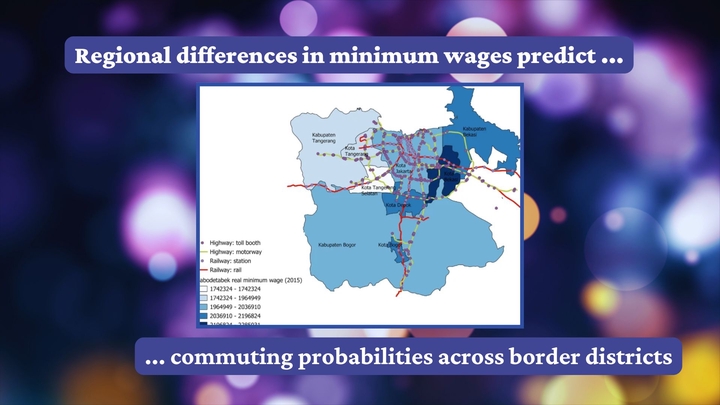
Following Indonesia’s fiscal decentralization, districts in Jabodetabek set distinct minimum wages. The 2015 distribution shows substantial variation across adjacent districts. Because commuting costs are lower than relocation costs, workers may respond to wage gaps by crossing district borders rather than migrating permanently.
🚆 Motivation 2: Why Commuting Matters
- 3.5–4.4 million daily commuters
- 21% of formal workers commute
- Employment data reflect residence, not workplace
During 2011–2015, commuting was widespread and predominantly in-person. Since labor surveys record residential location, ignoring cross-district mobility may bias estimates of minimum-wage effects. Policy evaluation must consider spillovers across administrative borders.
📊 Data and Methods
- Sakernas pooled cross-sections (2011–2015)
- Binomial logit model of commuting probability
- Home vs. cross-border minimum wages
- District and year fixed effects
The analysis exploits district-pair comparisons within a single metropolitan labor market. The key variables are real minimum wages at home and neighboring districts. The specification controls for demographics, macroeconomic factors, and spatial spillovers (SLX model).
🎓 Education Heterogeneity
- +0.9 ppts commuting per 100k IDR increase (average)
- College graduates: +1.7 ppts
- < High school: +0.3 ppts
Cross-border minimum wages significantly raise commuting probabilities. Responses are strongest among higher-educated workers, suggesting they benefit more from wage differentials and face lower mobility frictions.
💰 Income Heterogeneity
- High-income workers most responsive (+1.9 ppts)
- Minimum-wage earners moderately responsive
- Below-minimum earners: no significant effect
Commuting responses concentrate among workers earning above the minimum wage. Non-compliance weakens incentives for low-wage earners, highlighting institutional constraints in developing-country labor markets.
🌐 Spatial Spillovers
- Neighboring wages affect commuting
- Evidence robust to SLX model
- Spillovers vary across worker groups
Spatial lag models confirm that district policies generate measurable cross-border effects. While magnitude varies with specification, the qualitative conclusion remains consistent: wage-setting fragmentation transmits local shocks across the metropolitan system.
⚖️ Policy Implications
- Decentralized wage-setting creates internal borders
- Spillovers may distort employment statistics
- Coordination across districts is essential
Minimum wage differentials shape mobility patterns in integrated urban regions. Policymakers should consider harmonized frameworks or bounded dispersion rules to balance local autonomy with labor-market integration.
🔎 Key Takeaways
- Cross-border wage gaps increase commuting
- Effects heterogeneous by education and income
- Ignoring mobility biases policy evaluation
- Regional coordination improves welfare design
The evidence indicates that commuting is a key adjustment margin in decentralized labor markets. Incorporating worker mobility is essential for credible minimum-wage evaluation in metropolitan regions such as Jabodetabek.

Carlos Mendez
Associate Professor of Development Economics
My research interests focus on the integration of development economics, spatial data science, and econometrics to better understand and inform the process of sustainable development across regions.